
Discover what minimalist home design truly means in our 2026 guide. Simplify your space for a calm, functional living environment!


Minimalist home design is an interior design philosophy built on the principle that every object, surface, and space must earn its place. Rooted in architect Mies van der Rohe’s famous declaration that “less is more,” this approach strips a home back to its most functional, beautiful essentials rather than reducing it to emptiness. Research confirms that simplified home environments reduce cognitive load, improve focus, and lower anxiety. For homeowners in Singapore and beyond, minimalist interior design offers something genuinely rare: a home that feels calm the moment you walk through the door.
What are the key principles of minimalist interior design?
Minimalist interior design is defined by six core principles, and understanding them separates a genuinely considered space from one that simply looks bare. These principles work together to create rooms that feel both purposeful and restful.
- Clean lines and simple forms. Furniture and architectural elements follow geometric, unadorned shapes. A sofa with a straight profile and a flush-mounted door frame both contribute to the visual quiet that minimalism depends on.
- A limited, cohesive colour palette. Whites, warm greys, stone tones, and natural timber shades dominate. The palette is not chosen for neutrality alone but for how colours interact with natural light across the day.
- Functional objects only. Every piece of furniture and décor must serve a clear purpose. Decorative objects are permitted, but they are chosen with intention and placed with precision.
- Negative space as a design element. Borrowed from the Japanese concept of ma, negative space is the deliberate absence of objects. It gives the eye somewhere to rest and makes the objects that remain feel more significant.
- Concealed, integrated storage. Full-height handleless cabinetry with push-to-open hardware keeps surfaces clear without sacrificing practicality. Storage is not hidden as an afterthought; it is designed into the architecture from the start.
- High craftsmanship throughout. Because minimalist rooms contain so few elements, every joint, paint edge, and material finish is visible. Imperfections that would disappear in a busier room become focal points here.
Pro Tip: Before purchasing any new piece of furniture, ask two questions: does it serve a function, and does it belong to the same visual family as everything else in the room? If the answer to either is no, leave it out.
The precision required in joinery and finishes is one reason minimalist interiors often cost more than their appearance suggests. Simplicity, paradoxically, demands more skill to execute than complexity.

What benefits does minimalist design offer beyond aesthetics?
The appeal of minimalist home design goes well beyond how a room looks in a photograph. The real value is how the space makes you feel every single day.
“Minimalist living promotes well-being benefits including autonomy, competence, and positive emotions.” — 2024 research on minimalism and wellbeing
That finding matters because it reframes minimalism as a health decision, not just a style preference. When your home contains fewer competing visual demands, your nervous system is not working overtime to process them. Restrained palettes and clear hierarchies lower nervous system arousal, which is why a well-designed minimalist room feels peaceful rather than simply tidy.
Practically speaking, a minimalist home is also easier to maintain. Surfaces with nothing on them take seconds to clean. Integrated storage means possessions have a fixed home, so the low-level mental effort of locating things disappears. Over years, this compounds into a measurable reduction in daily friction. Tspacemall’s guide on effortless home living explores this idea in depth, showing how spatial discipline translates directly into a home that works for you rather than against you.
Natural light is another underrated benefit. Minimalist rooms are designed to maximise it. Well-designed window reveals and minimal window dressings flood interiors with daylight, which improves mood, supports circadian rhythms, and reduces the need for artificial lighting during the day.
How does minimalist design compare to other interior styles?
Minimalism is frequently confused with modern, Scandinavian, and even industrial design. Each shares some visual DNA with minimalism but operates on different values.
| Style | Palette | Texture | Clutter tolerance | Core value |
|---|---|---|---|---|
| Minimalist | Neutral, restrained | Deliberate, limited | Near zero | Function and spatial clarity |
| Modern | Neutral to bold accents | Smooth, polished | Low | Clean geometry and technology |
| Scandinavian | Warm whites, natural wood | Cosy, layered | Low to moderate | Hygge, warmth, and practicality |
| Maximalist | Rich, layered, contrasting | Abundant, mixed | High | Personal expression and abundance |
The most important distinction is between minimalism and maximalism. Where maximalism celebrates accumulation and layering, minimalism treats every addition as a decision that must be justified. Neither is superior. They simply reflect different relationships with objects and space.
Warm minimalism, a trend gaining significant traction in 2026, sits between classic cold minimalism and Scandinavian cosiness. Designers like Katie Harbison describe warm minimalism as replacing stark white palettes with earthy tones, linen textures, and natural stone, making spaces feel calm and personal rather than clinical. This evolution addresses the most common criticism of traditional minimalism: that it feels unwelcoming. Integrating character through considered details such as textured doors or warm timber frames is one practical way to achieve this balance.
The misconception that minimalism equals sterility is worth addressing directly. A minimalist room can contain a handwoven rug, a ceramic vase, and a well-chosen artwork. What it cannot contain is those things plus twenty others competing for attention.
How can homeowners create a minimalist interior?
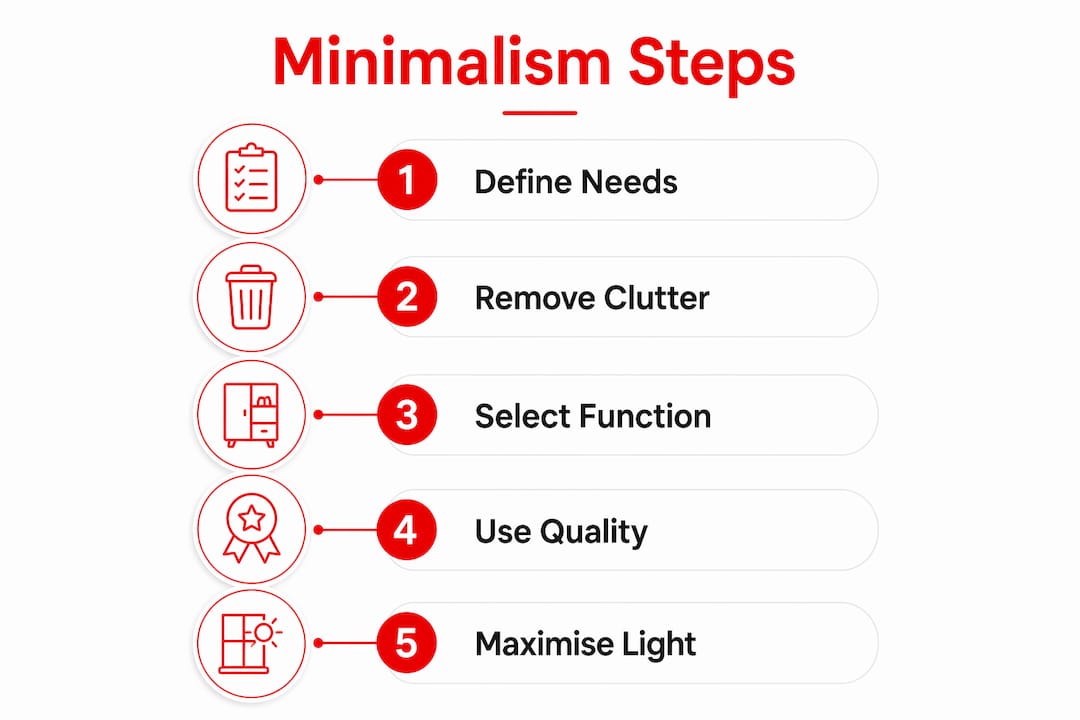
Creating a genuinely minimalist home requires a structured approach. Random removal of objects produces sparse, unfinished rooms rather than considered ones. The process below works because it starts with purpose, not possession.
- Define each room’s function before touching anything. A living room that also serves as a home office needs different storage logic than one used purely for relaxation. Decluttering without a defined purpose leads to rooms that feel incomplete rather than intentional.
- Categorise possessions by value, not location. The most effective approach is to sort by category across the whole home rather than going room by room. This reveals duplication and makes decisions easier.
- Select furniture for function and proportion. Each piece should serve a clear role and fit the scale of the room. A dining table chosen for a small Singapore home, for example, must balance seating capacity with the visual weight it adds to the space. Tspacemall’s guide on choosing a dining table is a practical reference for this decision.
- Invest in integrated storage solutions. Built-in cabinetry, under-bed drawers, and wall-mounted shelving keep possessions out of sight without requiring you to own less. Storage solutions designed to last prioritise durable hardware and clean profiles that age well.
- Maximise natural light. Remove heavy curtains where privacy allows. Use sheer linen panels instead. Position mirrors to reflect daylight deeper into the room.
- Choose quality over quantity in every material. One piece of solid oak furniture outperforms three pieces of veneer both visually and over time. Minimalism rewards investment in fewer, better things.
Pro Tip: Use interior design planning tools to visualise your space before committing to furniture placement or built-in joinery. Tspacemall’s list of design software tools covers the most practical options for Singapore homeowners.
What are the current trends and pitfalls in minimalist home design?
Minimalist design in 2026 is warmer, more textured, and more personal than it was a decade ago. Understanding where the style is heading helps you avoid creating something that already feels dated.
- Warm minimalism is the dominant direction. Earthy terracotta, warm sand, and aged brass replace the cold whites and chrome of earlier minimalism. The effect is a space that feels both edited and inviting.
- Texture is doing the work that colour once did. Bouclé upholstery, raked plaster walls, and honed stone surfaces add visual interest without introducing additional objects or competing colours.
- Treating minimalism as mere emptiness is the most common mistake. Rooms stripped of objects without a design intention behind the removal feel unfinished. Every surface that is left bare should be bare by decision, not default.
- Craftsmanship costs are higher than most homeowners expect. Because minimalist interiors require flawless execution, the budget for joinery, paint, and finishes is typically higher per square metre than in more decorative styles.
- Hardware and lighting quality are non-negotiable. In a room with few objects, a poorly chosen door handle or a harsh light fitting stands out immediately. These details carry disproportionate visual weight.
- Long-term maintenance requires ongoing discipline. Minimalism is not a one-time renovation outcome. It requires regular reassessment of what belongs in each space as life and needs change.
Key takeaways
Minimalist home design succeeds when every decision, from storage to material choice, is guided by function, spatial clarity, and deliberate restraint rather than the removal of objects alone.
| Point | Details |
|---|---|
| Philosophy over emptiness | Minimalism means deliberate selection, not bare rooms. Every object must earn its place. |
| Craftsmanship is critical | Simplified spaces expose every flaw, so quality of finish matters more, not less. |
| Well-being is measurable | Research links minimalist environments to reduced anxiety, greater focus, and positive emotions. |
| Warm minimalism is current | Earthy tones, natural textures, and considered details make minimalism liveable in 2026. |
| Start with purpose | Define each room’s function before decluttering to avoid sparse, unfinished results. |
Why minimalism rewards patience more than perfection
I have worked with enough homeowners to know that the first instinct when embracing minimalism is to remove things quickly and see immediate results. That instinct almost always produces disappointment. The rooms that genuinely feel minimalist are the ones where someone spent time deciding what the space was for before deciding what to put in it.
What surprises people most is the cost. A minimalist kitchen with handleless cabinetry and flush-fitted appliances often costs more than a kitchen with ornate detailing, because the precision required is higher and there is nowhere to hide a mistake. That is not a reason to avoid it. It is a reason to plan carefully and work with people who understand the standard required.
Minimalism also adapts to family life better than its reputation suggests. A home with children can still be minimalist if the storage is generous, the materials are durable, and the design accounts for how the family actually lives rather than how a showroom photograph suggests they should. The philosophy is not about austerity. It is about clarity. And clarity, once you have lived with it, is very hard to give up.
— Jonathan
Bring your minimalist vision to life with Tspacemall
If you are ready to move from inspiration to action, the right professional support makes the difference between a room that looks minimalist and one that genuinely feels it.

Tspacemall, located in the East of Singapore, brings together a curated selection of interior design firms and renovation specialists under one roof. Absolook Interior Design, one of the standout firms in the Tspacemall directory, specialises in residential minimalist styling and custom integrated storage solutions. Their team understands the craftsmanship demands that minimalism requires and can guide you from concept through to completion. You can also explore the full range of home and living renovation services available at Tspacemall to find the right partner for your project.
FAQ
What is minimalist home design in simple terms?
Minimalist home design is an interior approach that keeps only functional, high-quality objects and uses spatial clarity, restrained colour palettes, and integrated storage to create calm, uncluttered living spaces.
Is minimalist design suitable for families with children?
Yes. Minimalist design works well for families when storage is generous and materials are durable. The key is designing around how the family actually lives, with dedicated, concealed storage for everyday items.
Why does minimalist interior design often cost more?
Because minimalism requires flawless execution, there is no decorative complexity to mask imperfections. Joinery, paint finishes, and hardware must all meet a higher standard, which increases the cost per square metre compared to more ornate styles.
What is warm minimalism?
Warm minimalism is an evolution of classic minimalist design that replaces cold white palettes with earthy tones, natural textures like linen and stone, and considered details to create spaces that feel calm and personal rather than clinical.
How do I start creating a minimalist home?
Begin by defining each room’s purpose before removing anything. Then categorise possessions by value across the whole home, invest in integrated storage, and select furniture for function and proportion rather than decoration.
Recommended


