
Discover what is brand-led interior design and how it transforms spaces by reflecting your brand’s identity. Elevate your environment today!


Most people assume that adding a company logo to a feature wall is enough to call a space “branded.” It is not. What is brand-led interior design, really? At its core, it is the practice of translating a brand’s values, mission, and personality into every physical decision within a space, from the layout of furniture to the warmth of the lighting. Professionals in the industry often call this discipline space branding or branded interior design, and it goes far deeper than surface decoration. For homeowners and businesses in Singapore alike, understanding this concept opens the door to spaces that genuinely communicate who you are.
Table of Contents
- Key takeaways
- Defining brand-led interior design
- Why brand-led design matters
- How to implement brand-led design
- Commercial versus residential brand-led design
- Choosing the right designer for brand-led projects
- My honest take on brand-led interiors
- Find your brand-led design partner in Singapore
- FAQ
Key takeaways
| Point | Details |
|---|---|
| More than logo placement | Brand-led design translates strategy and values into layout, materials, colour, and light. |
| Works for homes too | Individuals can apply brand thinking to create cohesive, identity-driven living spaces. |
| Consistency is critical | A design-system alignment document keeps brand decisions intact through construction. |
| Sensory layers matter | Lighting, scent, and sound are core to brand recall, not optional extras. |
| Choose designers carefully | Ask about brand expertise and contract terms, not just style references. |
Defining brand-led interior design
Brand-led interior design means aligning every spatial decision with brand strategy and identity. It is not about decoration. It is about immersive storytelling through an environment, where a visitor or resident understands what a brand stands for before a single word is spoken. Think of a space as a three-dimensional brand manifesto. Every surface, every material, and every beam of light is a sentence in that story.
The elements involved go well beyond paint colours. They include:
- Spatial layout: how people move through the space and what they encounter first, second, and last
- Material selection: natural stone for a premium feel, raw concrete for an industrial identity, warm timber for a community-centred brand
- Colour palette: brand colours applied with intention to walls, furniture, fittings, and flooring
- Lighting design: the temperature and direction of light shaping mood and perceived quality
- Graphics and signage: brand typography and visual language woven into the architecture rather than applied as afterthoughts
The critical distinction between decorative design and brand-led design is intention. A decorative approach asks, “Does this look good?” A brand-led approach asks, “Does this feel like us?” Branded interiors reflect consistency and immersive storytelling across every element, whereas simple logo placement is a cosmetic solution that leaves the deeper brand story untold.
Pro Tip: Before any design brief is written, list three to five words that define your brand’s personality. Every material and spatial decision should pass the test: does this reflect those words?
Why brand-led design matters
The benefits of brand-led design become clearest when you consider what a space does to the people inside it. A well-executed branded interior does not just look impressive. It builds trust, triggers emotional responses, and creates the kind of memory that brings people back.
For businesses, the commercial case is strong. Consider these four reasons why brand-focused interior design pays off:
- It reinforces your brand mission physically. When a wellness brand uses natural materials, diffused lighting, and open circulation, the space confirms the promise the brand makes in its marketing. Customers feel the consistency, even if they cannot name it.
- It shapes the customer journey. Branded interiors map identity into the customer journey through spatial experience, including layout and atmosphere, meaning that every moment a customer spends in your space is a brand touchpoint working in your favour.
- It builds trust and loyalty. Branded spaces build trust and emotional connection, elevating business perception and encouraging repeat visits and long-term loyalty.
- It differentiates you from competitors. In Singapore’s competitive commercial environment, two businesses offering identical services will be judged on experience. The one with a coherent, intentional space almost always wins the perception battle.
For individuals, the logic is equally compelling. A home that reflects a clearly defined personal identity feels more settled, more purposeful, and more restorative. When your home’s materials, colours, and layout align with how you live and what you value, every room feels like it belongs to the same story. That is not a luxury outcome. That is good design thinking applied at a personal scale.
How to implement brand-led design
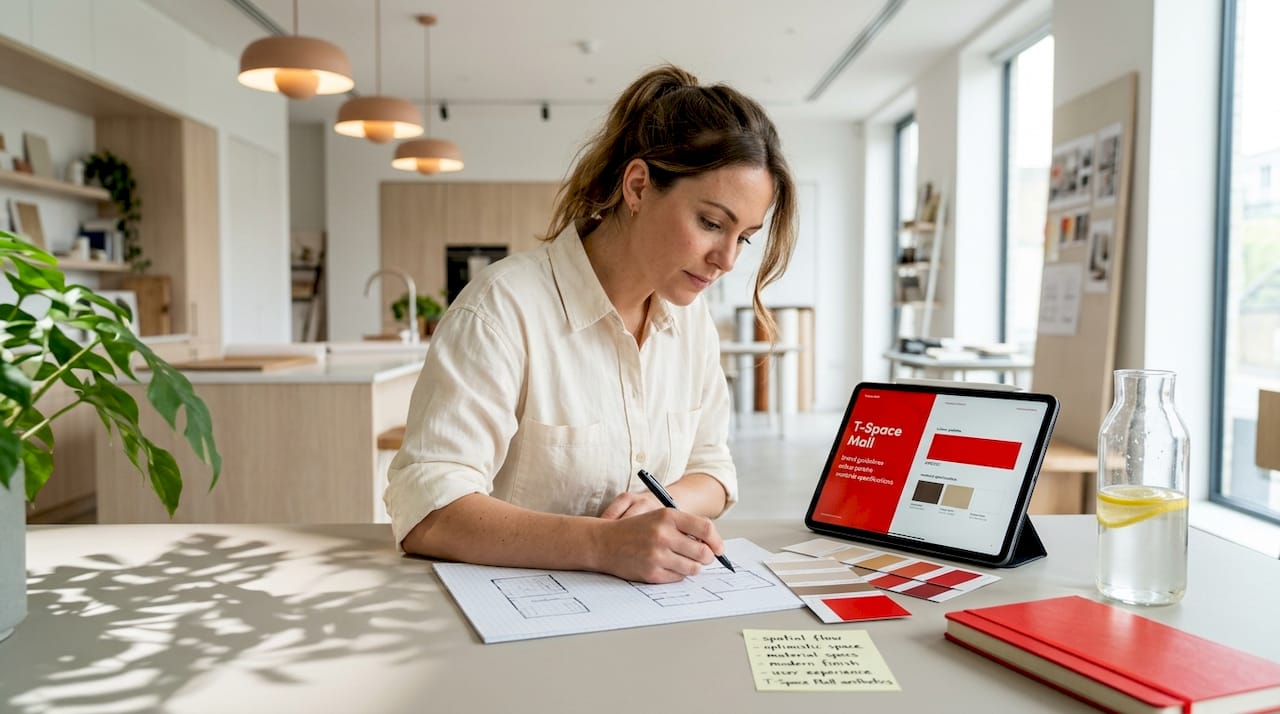
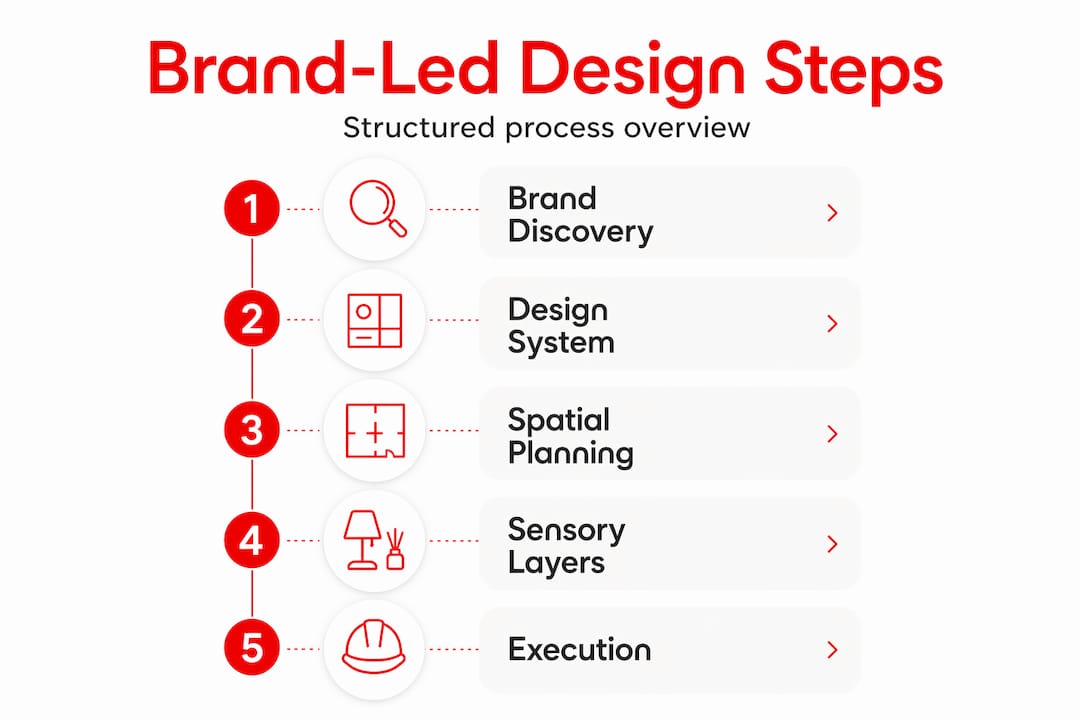
Getting brand-led design right requires a structured process. It does not begin with a mood board. It begins with research.
Research and brand discovery
Before any spatial decisions are made, the design team must understand the brand at depth. For commercial projects, this means stakeholder interviews to surface values, mission, target audience, and competitive positioning. For residential projects, it means honest conversations about how you actually live, what materials you are drawn to, and what your home should feel like to a visitor. This discovery phase is not optional. It is the foundation on which every subsequent decision rests.
Building a design system
Once the brand is understood, a design system is developed. This system specifies the colour palette, material library, typography for signage, lighting parameters, and graphic language. Think of it as a rulebook for the space. A design-system alignment document with detailed specifications prevents brand drift during procurement and construction, ensuring that what was agreed in the design phase is faithfully delivered on site.
| Without a design system | With a design system |
|---|---|
| Contractors substitute materials freely | Materials are specified and approved in advance |
| Brand colours shift between suppliers | Exact colour codes and finishes are documented |
| Signage feels disconnected from space | Typography and hierarchy are pre-agreed |
| Brand experience fragments room by room | Coherent narrative carries through the entire space |
Spatial planning and sensory layers
Layout must reflect how your brand operates and how people should move through the space. A brand centred on openness and collaboration will favour open-plan arrangements and shared surfaces. A brand built on exclusivity will use controlled entry points and private zones. Beyond the visual, sensory layers such as lighting, sound, and scent planned as part of the brand narrative significantly augment brand recall and emotional connection. These are not decorative extras. They are core to how the brand experience lands.
Pro Tip: For Singapore projects specifically, consider how the tropical climate affects material choices. Natural timber and rattan carry warmth that resonates locally, but they require climate-appropriate treatments to perform well in humidity. Brand authenticity must survive the weather.
Commercial versus residential brand-led design
Brand-led thinking applies differently depending on whether you are fitting out a shopfront in Katong or redesigning your HDB flat in Tampines. The goals differ, the scale differs, and the resources available differ. But the underlying principle stays the same: every space should tell a coherent story.
| Dimension | Commercial spaces | Residential spaces |
|---|---|---|
| Primary goal | Communicate brand to customers and build loyalty | Express personal identity and support how you live |
| Scale | Larger, multi-zone environments | Intimate, room-by-room application |
| Budget drivers | ROI on customer experience and footfall | Personal satisfaction and resale value |
| Key stakeholders | Business owners, brand managers, customers | Homeowner and family members |
| Success measure | Brand recall, dwell time, repeat visits | Comfort, coherence, and daily enjoyment |
For commercial entities, brand-led design means treating the entire customer journey as a sequence of brand moments. A café brand might use the queuing area to communicate its sourcing story through materials and graphics, with the seating area shifting to a warmer, more relaxed palette that invites longer stays.
For individuals at home, brand-centric thinking creates cohesive lived experiences where interior elements reinforce a defined identity narrative rather than just aesthetic choices. Here are some practical ways to bring that thinking into a residential project:
- Define two or three words that describe how you want your home to feel, such as “calm, natural, and playful”
- Choose one or two anchor materials that express those words, such as pale oak flooring and linen soft furnishings
- Apply those anchor choices consistently across rooms to create visual continuity
- Use lighting temperature intentionally: warmer tones in social spaces, cooler tones in workspaces
- Let an art selection checklist guide wall choices so artwork reinforces the identity rather than contradicting it
Choosing the right designer for brand-led projects
The quality of the outcome depends significantly on the professional you work with. Not every interior designer understands space branding, and a designer who is strong on aesthetics may still miss the strategic layer that makes brand-led design effective.
When evaluating potential designers or firms, go beyond their portfolio. Ask specifically about their process for understanding a brand before spatial decisions are made. Ask what documentation they produce to maintain brand consistency through the build phase. Evaluating designers for brand-led projects should include questions on scope, material specifications, revision terms, warranty coverage, and who holds ownership of the design documents.
Specific questions worth asking any prospective designer include:
- “Can you show me a project where the spatial design was driven by brand strategy rather than aesthetics alone?”
- “What does your design-system documentation look like, and who controls it during procurement?”
- “How do you handle material substitutions if a specified item becomes unavailable mid-project?”
- “What post-handover support do you provide if details do not match the agreed specification?”
For Singapore specifically, look for firms with experience in the local regulatory environment, including HDB guidelines and URA planning rules, as these directly affect what is spatially achievable. Singapore design firms offering localised, end-to-end brand-led design and build services understand how to balance brand ambition with what is practically executable here.
Understanding what a client brief covers before your first meeting with a designer will help you ask sharper questions and get more useful responses.
Pro Tip: Ask any shortlisted designer to explain your brand back to you after an initial briefing session, before they show you any visuals. How accurately they capture your identity tells you more than any mood board could.
My honest take on brand-led interiors
I have watched too many spaces in Singapore launch with genuine ambition and arrive at a result that feels hollow. The brief was strong. The budget was adequate. The designer was talented. But somewhere between the concept and the site, the brand story slipped out of the room.
In my experience, the most common failure is treating brand-led design as a phase rather than a throughline. Teams invest properly in the discovery and concept phase, then hand execution off to contractors who have not seen the design-system document and are simply trying to hit a deadline. The result is a space that looks roughly right but does not feel right. The materials are slightly off. The lighting temperature was never adjusted from the default. The signage was printed in the wrong typeface because no one checked.
The spaces I have seen get it right share one thing: the client stayed engaged throughout the build, not just the design. They asked questions. They pushed back on substitutions. They trusted their brief enough to defend it when costs pressured decisions.
Brand-led interiors are not finished when the designer signs off. They are finished when the space genuinely feels like an extension of the identity it was built to express. That takes attention at every stage, from the first conversation to the final walkthrough.
— Jonathan
Find your brand-led design partner in Singapore
If the principles here resonate, the next step is finding a firm that can translate them into your actual space. Tspacemall brings together a curated selection of interior design professionals and renovation specialists under one roof in the East of Singapore, making it straightforward to find the right expertise for both residential and commercial brand-led projects.
Firms such as Absolook Interior Design and Woodcraft Interior Design work across both commercial and residential contexts, bringing the kind of strategic thinking that brand-led design demands. Whether you are fitting out a retail space in the East or rethinking your home’s identity from the ground up, the design and renovation directory at Tspacemall gives you direct access to trusted professionals who understand Singapore’s unique design environment. Explore the directory, visit the mall, and take the first step toward a space that genuinely feels like you.
FAQ
What is brand-led interior design in simple terms?
Brand-led interior design is the process of expressing a brand’s values, mission, and personality through spatial decisions such as layout, materials, colour, and lighting, rather than simply placing logos in a room.
Can individuals use brand-led design in a home?
Yes. Homeowners can apply brand-led thinking by defining a clear personal identity for their space and making consistent material, colour, and lighting choices that reinforce that identity across every room.
How does brand-led design differ from ordinary interior design?
Ordinary interior design focuses primarily on aesthetics and function. Brand-led design adds a strategic layer, ensuring that every spatial element communicates a specific identity and creates a coherent, emotionally resonant experience.
What is a design-system alignment document?
It is a specification document produced by the design team that records the approved colour palette, material library, typography, signage hierarchy, and lighting parameters, helping to prevent brand inconsistency during construction.
How do I find brand-led interior designers in Singapore?
Look for designers with demonstrated experience in space branding and ask to see projects where brand strategy drove spatial decisions. Tspacemall’s directory connects you with vetted firms in Singapore that offer these capabilities.
Recommended


