
Learn how to select a dining table for your small home in Singapore. Maximize space and style with our essential tips and guide!


Choosing the right furniture for a compact flat is never simple, but learning how to select a dining table for a small home is where many new homeowners feel the pressure most acutely. Singapore’s BTO and condominium units are notoriously tight on square footage, yet the dining area still needs to function beautifully every single day. Get this decision right and your entire living space opens up. Get it wrong and you spend years squeezing past chairs and apologising to guests. This guide walks you through everything you need to know, from precise measurements to smart table styles and common mistakes worth avoiding.
Table of Contents
- Understanding your space and needs before choosing a dining table
- Choosing the right dining table style and size for small homes
- Matching dining table height and seating for ergonomic comfort
- Installing and maintaining space-saving features for small dining tables
- Avoiding common mistakes when selecting dining tables for small homes
- Redefining small dining spaces: fresh thinking beyond traditional furniture choices
- Find space-efficient dining solutions with T-Space Mall’s expert interior design services
- Frequently asked questions
Key Takeaways
| Point | Details |
|---|---|
| Measure your space carefully | Accurate measurements and clearance planning ensure your dining table fits comfortably without obstructing movement. |
| Choose adaptable styles | Round, drop-leaf, and foldable tables offer flexibility and save space in small homes. |
| Mind ergonomic dimensions | Select tables and chairs with proper height and clearance for dining comfort and posture support. |
| Prioritise lightweight furniture | Light, easy-to-move dining tables maintain your room’s multifunctional potential. |
| Secure proper installations | Ensure wall-mounted tables are anchored into studs for safety and durability. |
Understanding your space and needs before choosing a dining table
To choose the perfect dining table, first understand the spatial limits of your dining area and how you actually use it day to day.
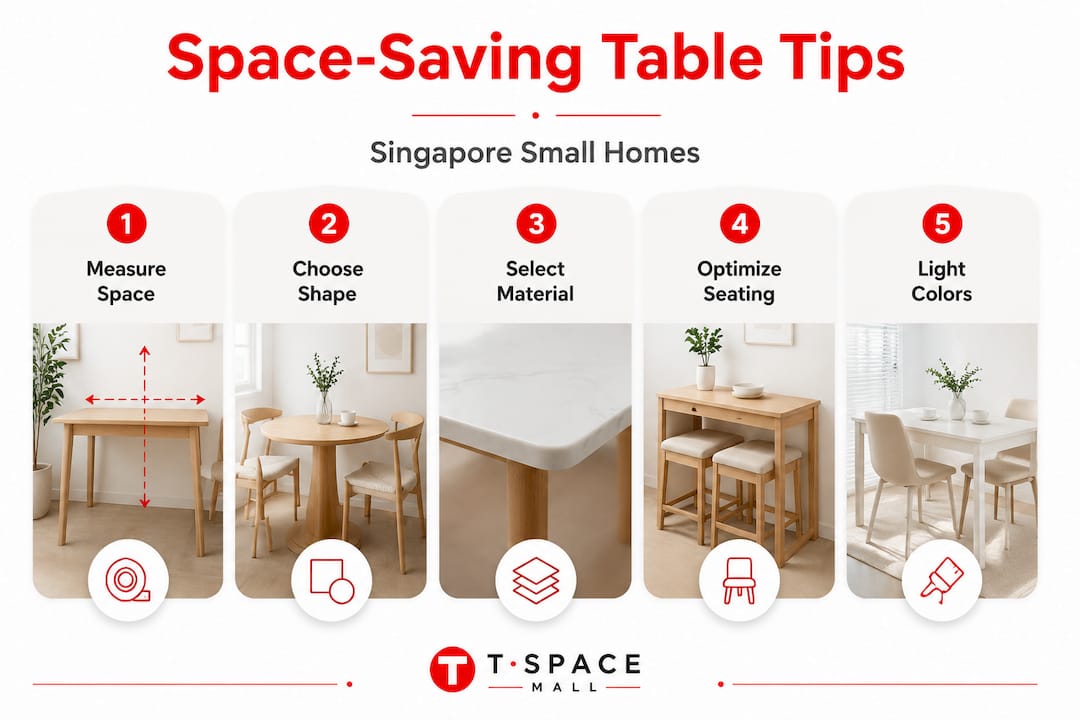
Before you even glance at a furniture catalogue, grab a measuring tape. Knowing the exact dimensions of your dining zone prevents the single most common regret among new homeowners: buying a table that physically fits the room but makes the entire area feel suffocating. The room’s footprint is not your table’s footprint. You need to account for the zone of activity, which is the space required to pull out chairs, seat guests, and move behind them without a squeeze.
As a practical starting point, at least 90 to 100 cm clearance should be maintained from the nearest wall or sideboard to the table edge. If the dining area doubles as a through-route to the kitchen or living room, push that figure to 120 cm. This is not padding. It is the minimum you need to live comfortably.
Here is a quick checklist to run through before selecting a dining table for your small home:
- Measure the total floor area of your dining zone, not just the wall width
- Mark out where doors and walkways intersect with the space
- Note the position of power sockets, windows, and air-conditioning units
- Confirm whether the space also serves as a workspace or play area
- Allow for the table’s full extended size if you are considering a foldable design
The table below gives a practical reference for matching room size to table dimensions in typical Singapore homes.
| Dining area size | Recommended table size | Max seated comfortably |
|---|---|---|
| 2 m x 2 m | 80 cm round or 70 x 100 cm rectangular | 2 to 4 persons |
| 2 m x 3 m | 90 cm round or 80 x 120 cm rectangular | 4 persons |
| 2.5 m x 3 m | 100 cm round or 80 x 140 cm rectangular | 4 to 6 persons |
| 3 m x 3 m | 120 cm round or 90 x 160 cm rectangular | 6 persons |
Pro Tip: Lay newspaper sheets or masking tape on the floor in the shape of your intended table before purchasing. Live with the outline for a day. You will immediately sense whether the clearance feels right or restrictive.
If your dining area also serves as a home office or study corner, factor in the chair pull-back distance from multiple angles. The experts at T-Space Mall’s home design and renovation advice directory often see clients who forget this step, then find themselves unable to open a laptop at the table without bumping into a wall. Good interior design expertise starts precisely here, with measurements rather than mood boards.
Choosing the right dining table style and size for small homes
With your space measured, the next step is to explore table styles that match your layout and lifestyle.
Shape matters more than most people expect. A rectangular table feels natural against a wall but can act like a room divider in a compact space, cutting off flow and making the room feel severed in two. Round and oval tables, by contrast, are kinder to small rooms. They eliminate sharp corners that bruise hips and create a naturally sociable seating arrangement. Round and pedestal-base tables improve circulation, reduce corner hazards, and simply feel less bulky in a tight room.
For truly versatile small space dining options, foldable and drop-leaf tables deserve serious consideration. Drop-leaf tables transform from a slim console sitting against the wall into a full dining surface when guests arrive. On an ordinary Tuesday evening, the table occupies perhaps 30 cm of depth against a wall. On Sunday when the family visits, it unfolds to seat six comfortably. That kind of flexibility is particularly valuable in Singapore’s smaller flat types where every square centimetre earns its keep.
| Table style | Best suited for | Space efficiency | Flexibility |
|---|---|---|---|
| Round with pedestal base | Square rooms, sociable layouts | High | Low |
| Drop-leaf or fold-out | Very small flats, dual-purpose rooms | Very high | Very high |
| Extendable rectangular | Narrow rooms with occasional large gatherings | Medium | Medium to high |
| Fixed rectangular | Rooms with dedicated dining space | Medium | Low |
| Wall-mounted fold-down | Kitchens, studio flats | Very high | High |
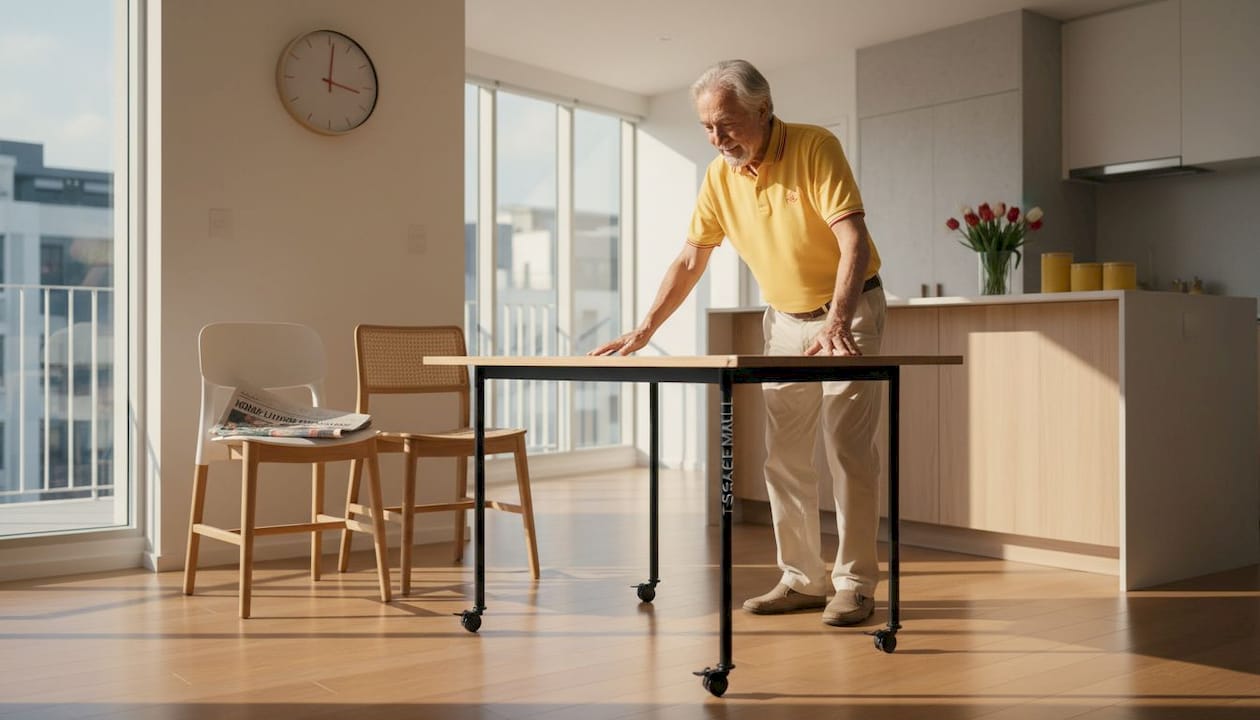
When selecting a dining table for a small home, weight and mobility also matter. A lightweight table you can push aside doubles your living room’s function on movie nights or during children’s activities. Heavy stone or solid timber tables look stunning but behave like anchors in compact rooms.
Pro Tip: For dining table ideas for small homes where natural light is limited, choose tables with glass tops or light timber finishes. They reflect light rather than absorbing it, making the room feel airier without any structural changes.
These visual space expansion tips extend beyond furniture shape. Your choice of colour, material, and leg style all contribute to whether a room breathes or suffocates. Explore the range of dining solutions for small homes at T-Space Mall to see how different styles perform in rooms similar to yours.
Matching dining table height and seating for ergonomic comfort
After selecting your table style, pairing it with the right seating height ensures hours of comfortable dining rather than an aching back and stiff shoulders.
This pairing is where many compact dining table purchases quietly go wrong. A beautiful table bought separately from its chairs can create a mismatch that makes every meal feel awkward. The standard dining table height in Singapore sits between 710 and 760 mm, with a recommended seat-to-table clearance of 250 to 300 mm. That clearance is the gap between the top of the chair seat and the underside of the table.
Here are the key ergonomic measurements to keep in mind:
- Table height: 710 to 760 mm from floor to tabletop surface
- Chair seat height: 420 to 460 mm from floor to seat surface
- Seat-to-table clearance: 250 to 300 mm minimum
- Under-table leg clearance: at least 600 to 650 mm for comfortable seated posture
- Per-person dining width: allow a minimum of 600 mm of table width per seated diner
| Measurement | Recommended range | Why it matters |
|---|---|---|
| Table height | 710 to 760 mm | Allows arms to rest naturally without hunching |
| Chair seat height | 420 to 460 mm | Keeps feet flat on floor, reducing lower back strain |
| Seat-to-table gap | 250 to 300 mm | Allows legs to move freely beneath the surface |
| Under-table leg space | 600 to 650 mm minimum | Prevents cramped posture during long meals |
Tabletop thickness is a detail that surprises many first-time buyers. A slab-style timber top that is 60 mm thick eats into your leg clearance by that same 60 mm from below. If the table is already at the lower end of the height range, a thick top can make dining noticeably uncomfortable. Ask for the underside clearance measurement, not just the overall table height, when speaking with a retailer.
Pro Tip: If you are buying a bench instead of chairs for one side of the table, benches typically sit 40 to 50 mm lower than standard dining chairs. Check the clearance figure before purchasing to avoid an uncomfortable slouch.
The ergonomic dining setups available at T-Space Mall include options from retailers familiar with Singapore home proportions. For a bespoke solution that accounts for your specific room and seating combination, the custom dining furniture specialists can guide you toward the right configuration from the very beginning.
Installing and maintaining space-saving features for small dining tables
Equipped with knowledge of table types and comfort requirements, let us examine how to safely install and maintain your chosen table for long-term reliability.
Wall-mounted fold-down tables are among the best small dining tables for studio flats and tiny kitchens, but they are only as good as their installation. A poorly anchored wall-mounted table is not just an inconvenience. It is a genuine safety hazard. The rule is straightforward: always anchor into wall studs, not just the plasterboard. Securing into wall studs is essential for carrying the weight of a loaded dining surface safely.
Follow these steps when installing a wall-mounted dining table:
- Locate and mark wall studs using a stud finder before drilling
- Use appropriate wall anchors rated for the table’s maximum load
- Check that the bracket sits level before final tightening
- Test the table’s stability by applying downward pressure before use
- Have a second person assist to hold the unit in position during installation
For drop-leaf tables, the hinges and support mechanisms do the heavy lifting every time the leaf is raised or lowered. Over months of daily use, these components can loosen or wear down.
- Inspect hinges and folding brackets every three to six months
- Tighten any loose screws before they cause wobble or misalignment
- Apply a small amount of furniture wax or silicone spray to metal hinges to keep them operating smoothly
- Avoid placing very heavy items on an extended drop-leaf, as the support brackets have a rated load limit
“A dining table that feels effortless to reconfigure is one you will actually reconfigure. Reliable mechanisms are not a luxury feature. They are what separates a transformable dining table from an expensive ornament.”
Pro Tip: Keep a small toolkit in your kitchen drawer with a screwdriver and an Allen key sized for your table’s hardware. A five-minute tighten every few months prevents a wobbly table from becoming a trip to the furniture shop.
Consult T-Space Mall’s interior renovation tips directory for contractors and specialists who understand the specific wall construction types found in Singapore HDB flats and condominiums. For complex wall-mounted installations, expert installation advice from a professional is always the safer route.
Avoiding common mistakes when selecting dining tables for small homes
Knowing how to avoid these pitfalls ensures you enjoy your dining area fully without costly regrets.
The experts at T-Space Mall have seen the same errors repeated across countless renovation projects. These mistakes are entirely avoidable with a little advance planning.
- Choosing furniture that is too heavy to move. Overly heavy or hard-to-move pieces reduce the room’s ability to serve multiple purposes, which matters enormously in small Singapore homes where one room often pulls double duty.
- Underestimating clearance requirements. Neglecting proper clearance creates cramped zones of activity that disrupt flow and make guests feel unwelcome the moment they try to push back their chairs.
- Buying the table and chairs separately without checking height compatibility. This is a surprisingly common issue that leads to either a hunched dining posture or chairs that sit so low the table feels like a shelf.
- Skipping professional installation for wall-mounted solutions. DIY installation into plasterboard without locating studs is a structural safety risk, not a cost-saving measure.
Here are additional considerations that often slip through the cracks:
- Do not choose a table purely based on how it looks in a showroom, which is typically a large, well-lit space that flatters oversized furniture
- Avoid dark, heavily grained timber tops in rooms with limited natural light, as they can make a small space feel smaller still
- Do not ignore the table’s leg position. Four corner legs on a small rectangular table offer fewer flexible seating arrangements than a central pedestal or trestle base
“The biggest mistake is treating the dining table as just a dining table. In a small home, it is a workspace, a gathering point, and sometimes a craft station. Choose accordingly.”
Reviewing these avoiding cramped layouts strategies alongside the space planning guidelines available at T-Space Mall can save you from an expensive and frustrating do-over.
Redefining small dining spaces: fresh thinking beyond traditional furniture choices
There is a conventional approach most homeowners take when furnishing a new flat. They visit a furniture retailer, choose a dining set that looks the part in the showroom, bring it home, and then spend months working around it rather than with it. The dining table becomes the room’s landlord, dictating where everything else goes.
This thinking needs to change. In Singapore’s compact homes, the dining table should behave more like a good flatmate: present when needed, out of the way when not, and adaptable enough to support whatever the day demands. Transformable, lightweight designs support multiple daily activities beyond dining, from remote work to children’s homework to weekend craft projects. A fixed, heavy table simply cannot do this.
The deeper insight is that prioritising adaptability over aesthetics alone is not a compromise. It is actually the more sophisticated choice. A beautifully designed drop-leaf table that disappears when not in use is smarter than a fixed statement piece that commands permanent attention. Space planning should start with the question “what do I need this space to do?” rather than “what table do I want to own?”
Dense urban living in Singapore is not going to offer more square footage anytime soon. The homes that feel genuinely liveable are the ones where the furniture serves the lifestyle rather than the other way around. Explore the space expansion perspective that the team at T-Space Mall champions. It reshapes how you think about every piece of furniture in your home, not just the dining table.
Find space-efficient dining solutions with T-Space Mall’s expert interior design services
Navigating the world of compact dining table options is far easier with the right guidance beside you.

T-Space Mall, located in the East of Singapore, brings together trusted home living interior design and renovation specialists under one roof, making it the natural first stop for new homeowners planning a small-home dining setup. Whether you need help measuring your space, selecting a space-saving table, or arranging a professional wall-mount installation, the right expert is just a conversation away. The team at Absolook Interior Design is particularly experienced in maximising small Singapore dining areas with tailored design solutions. Visit T-Space Mall to explore the full range of furniture retailers, interior designers, and renovation contractors ready to help you create a dining area that genuinely works for your home and your lifestyle.
Frequently asked questions
What is the ideal clearance space around a dining table in a small Singapore home?
Leave at least 90 to 100 cm clearance from the table edge to nearby walls or furniture for comfortable movement, increasing to around 120 cm if the area is a regular through-route.
Are drop-leaf dining tables good for small homes?
Yes, drop-leaf tables transform from a slim console into a full dining surface on demand, making them one of the most practical small space dining options for compact Singapore flats.
What table height is recommended for comfort in Singapore dining rooms?
A standard dining table height of 710 to 760 mm, paired with a seat-to-table clearance of 250 to 300 mm, delivers comfortable, ergonomically sound dining posture for most adults.
How important is lightweight furniture for small living areas?
Heavy or hard-to-move furniture significantly reduces a small room’s ability to serve multiple purposes, so choosing lightweight, mobile pieces is one of the most practical decisions you can make for a compact home.
Recommended


