
Struggling to decorate your new home after renovation? Discover essential steps and tips to create a space that truly reflects your style.


The moment renovation wraps up, most homeowners expect the hard part to be over. But when you finally stand in your freshly renovated space and try to decorate new home after renovation, a strange paralysis sets in. Where do you start? What goes in first? Should you buy the rug before the sofa, or the lamp before the paint? These questions are not trivial. Getting the sequence wrong does not just cost money; it costs you the home you actually wanted. This guide walks you through the correct order, common traps, and practical steps to transform your renovated Singapore home into a space that feels genuinely yours.
Table of Contents
- Understanding the decorating challenges after renovating a new home
- Preparing your new home for decoration: what you need to know first
- Executing your decoration plan: step-by-step guide for seamless style and function
- Common mistakes to avoid and how to troubleshoot decorating challenges
- Expected results and how to verify your home decoration success
- Why decorating your renovated home is a step-by-step art, not a bags-of-tricks approach
- Find expert interior design and renovation services for your new Singapore home
- Frequently asked questions
Key Takeaways
| Point | Details |
|---|---|
| Follow decorating sequence | Decorating must be done in the correct order; foundation pieces first, accents last to avoid mistakes. |
| Prioritise function | Focus on how your home works day-to-day after renovation before aesthetics for lasting comfort. |
| Prepare thoroughly | Take accurate measurements and understand your renovation timeline and budget before buying. |
| Allow adjustment time | Live in your space 48-72 hours before making final decoration decisions to ensure suitability. |
| Seek expert help | Professional interior design services can ensure your decorating is both stylish and functional. |
Understanding the decorating challenges after renovating a new home
The biggest surprise for most new homeowners is that decorating after renovation is harder than the renovation itself. Not because style is difficult, but because the sequencing is invisible. Nobody hands you a rulebook. You see a cushion you love, a light fitting that feels perfect, a rug that seems like it was made for your living room. So you buy them. Then the sofa arrives and nothing fits.
Sequencing errors, not poor taste, account for 70% of living room redesign regrets. Homeowners buy accent pieces before furniture layout is confirmed, and the entire room unravels. The issue is not your eye for design. It is that you are solving the wrong problem first.
Consider what actually happens. You lock in a lamp position. Then the sofa arrives and blocks the wall socket. You choose a rug that looks stunning in the shop but sits awkwardly under a coffee table you have not yet bought. These are not style failures. They are decorating order and sequence failures, and they happen to experienced decorators who skip the planning phase.
Here is what poor sequencing typically looks like in practice:
- Buying cushions, throws, and ornamental pieces before the main sofa is positioned
- Choosing wall art before knowing where the television console will sit
- Selecting a statement pendant light without accounting for ceiling height and furniture scale
- Painting walls before all cabinetry and joinery installations are complete
- Placing small accent furniture before traffic flow patterns are tested
“Decoration is not a bag of tricks you open in any order. Each decision depends on what came before it. The sofa is not just a sofa; it is the anchor from which everything else takes its measurement.”
Now that we recognise why decorating after renovation can be tricky, let us prepare properly to avoid these pitfalls.
Preparing your new home for decoration: what you need to know first
With a solid understanding of the challenges, preparing your home carefully sets you up to decorate effectively. Before a single piece of furniture enters the room, three things need to happen: measurement, budget alignment, and a functional audit.
Step 1: Measure before you buy anything
Take accurate measurements of every key space, including ceiling height, window positions, door swing clearances, and floor area. Use masking tape on the floor to simulate furniture footprints. This step alone eliminates most size-related purchasing errors.

Step 2: Align your decoration budget with renovation realities
Renovation costs in Singapore vary significantly. Minor bathroom and laundry renovations typically cost around $25,000, while larger kitchen and bathroom revamps can reach $90,000 with timelines stretching from two weeks to four months. Understanding where your renovation budget landed helps you allocate realistically for furnishing and decoration without overextending.
Step 3: Complete a functional audit before decorating begins
Do not decorate over problems. In Singapore, the post-handover phase calls for a thorough functional check before any decoration starts. This means testing plumbing, electrical circuits, air-conditioning drainage, ventilation, and door seals. A beautiful sofa positioned against a leaking wall panel is a future nightmare.
Here is a useful reference to guide your pre-decoration preparation:
| Preparation task | Why it matters | When to do it |
|---|---|---|
| Room measurements | Prevents furniture sizing errors | Before any shopping |
| Budget review | Aligns spending with renovation costs | After renovation handover |
| Functional audit | Catches defects before decor covers them | Within first 48 hours |
| Traffic flow test | Confirms practical layout options | Before furniture delivery |
| Lighting assessment | Reveals how natural light affects colours | Different times of day |
Pro Tip: Visit your home at three different times during the day, morning, afternoon, and early evening, to observe how natural light moves through each room. This single step will change every paint and fabric decision you make.
Understanding home functionality after renovation before you layer decoration on top is not excessive caution; it is the difference between a home that works and one that just looks like it should.
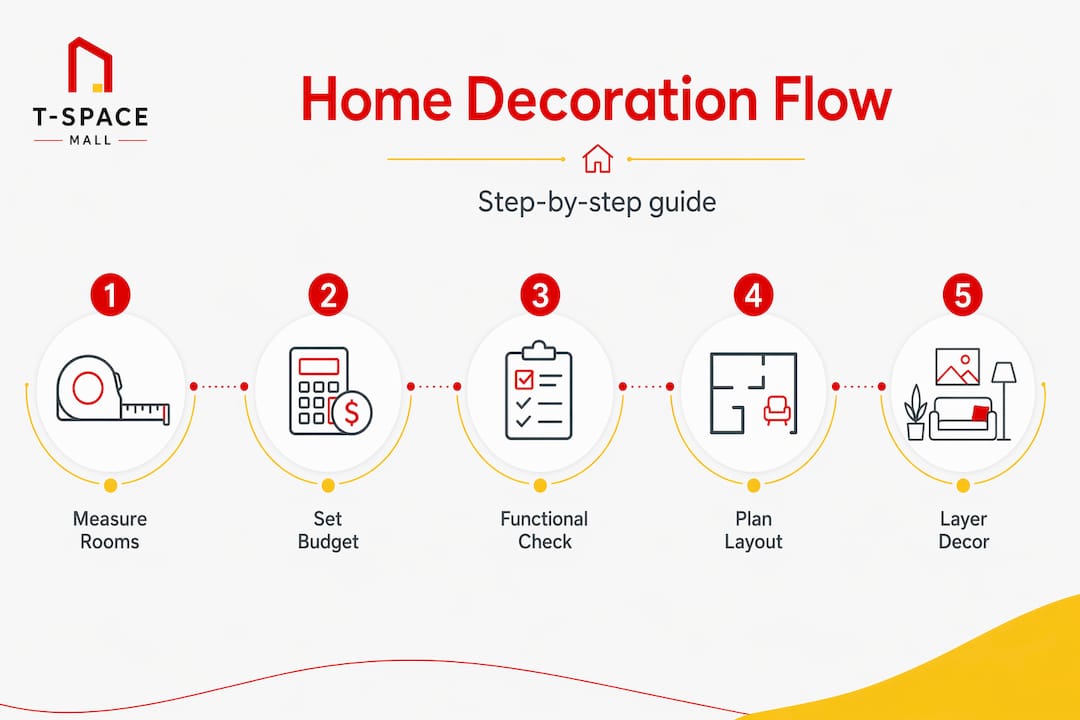
Executing your decoration plan: step-by-step guide for seamless style and function
Armed with preparation, following a disciplined sequence will help you bring your decoration plans to life successfully. Think of your home as a canvas where each layer must dry before the next is applied.
The correct decoration sequence:
- Place your largest anchoring furniture first. The sofa in the living room, the bed in the bedroom, the dining table in the dining area. These pieces define traffic flow, sight lines, and every subsequent decision. Decoration is a dependency chain, and the sofa is the first link.
- Select and position your rug second. The rug should respond to the furniture, not the other way around. Front legs of all main seating on the rug is the standard rule for grounding a room visually.
- Plan your layered lighting before committing to wall paint. Different light temperatures, warm versus cool, dramatically alter how paint colours read on a wall. Confirm your overhead, task, and ambient lighting plan before you open a paint tin.
- Paint walls and ceilings after lighting is confirmed. This sequence means your chosen colour looks the same in real life as it did in your head.
- Choose one high-impact feature and build around it. In 2026, design experts recommend prioritising one standout element rather than attempting full-scale revamps. A statement wall panel, an architectural pendant light, or a bespoke shelving unit gives the room a clear focal point.
- Apply the subtract-first rule before adding accessories. Before buying anything new, remove everything from the space that does not belong. A curated room with fewer pieces almost always reads as more considered than one crowded with accents.
Here is a practical comparison of the disciplined approach versus the common rushed approach:
| Decision | Disciplined approach | Rushed approach |
|---|---|---|
| Sofa placement | Confirmed before any other purchase | Bought based on style alone |
| Rug selection | Chosen after sofa is in position | Bought before furniture arrives |
| Paint colour | Tested under confirmed lighting | Chosen from a chip in the shop |
| Accent pieces | Added last as finishing layers | Purchased first impulsively |
| Feature element | One deliberate focal point | Multiple competing focal points |
Pro Tip: Use the free interior design and renovation steps resources at T-Space Mall to map out your decoration dependencies before you start shopping. Seeing the sequence written down makes it far harder to skip a step.
Common mistakes to avoid and how to troubleshoot decorating challenges
Knowing the right steps is crucial, but understanding how to avoid and fix errors ensures your decorating success. Even well-prepared homeowners fall into familiar traps.
The most avoidable mistakes in post-renovation decor:
- Purchasing accent pieces before furniture is placed. This is the leading cause of decoration regret. A rug bought without the sofa present is rarely the right size.
- Painting at the wrong stage. Painting should happen after major installations like cabinetry are complete but before flooring goes down. This protects surfaces and produces a cleaner result.
- Making impulsive colour decisions in the shop. Paint samples look entirely different on a wall under your home’s specific lighting. Always test a sample patch of at least 30 centimetres square and observe it across the day.
- Skipping the 72-hour review period. Before confirming any significant purchase, live with the space for at least 72 hours. What feels exciting in the showroom often feels wrong at home after two days.
- Over-accessorising to fill silence. Empty corners and blank walls are not problems to be solved with objects. Sometimes the right answer is restraint.
“The costliest decoration failures have nothing to do with choosing the wrong colour or style. They come from buying things in the wrong order.”
Getting expert guidance on avoiding decorating errors early in the process is one of the most practical investments a new homeowner can make. Professional interior designers do not just have better taste; they have a system, and the system is the advantage.
Pro Tip: Keep a running spreadsheet of every item you intend to buy, categorised by its position in the decoration sequence. If an item is in column C but columns A and B are not yet confirmed, do not buy it.
Expected results and how to verify your home decoration success
After troubleshooting, it is essential to verify that your home performs well and looks as expected for lasting satisfaction.
A common mistake is to treat the end of the decoration process as the moment everything arrives and is placed. In reality, the first 48 to 72 hours of occupancy is your most valuable verification window. Post-renovation issues reveal themselves in this period, from air-conditioning units that do not cool efficiently to light switches that trip circuits when used together.
What to check in your verification phase:
- Air-conditioning performance across all rooms under normal usage conditions
- Plumbing pressure and drainage speed in all bathrooms and kitchen
- Electrical circuit behaviour when multiple appliances are used simultaneously
- Door and window seals for air leakage, which affects both comfort and energy costs
- Furniture placement for practical daily flow, not just visual appeal
Minor settling, small gaps, slight paint variations near joins, these are normal in a newly renovated home and rarely warrant immediate contractor intervention. Document everything you notice clearly with photographs and written descriptions to make any follow-up conversations with your contractor straightforward.
For the decoration side, a useful benchmark: a bedroom refresh completed over eight weeks on a budget of $1,500 can deliver a genuinely noticeable transformation. This gives you a realistic frame of reference for what targeted effort and budget can achieve without a full overhaul.
| Verification area | What to look for | Normal vs. concern |
|---|---|---|
| Air-conditioning | Cooling efficiency and drainage | Minor noise is normal; water pooling is a concern |
| Plumbing | Pressure and drainage speed | Slow drain needs attention within two weeks |
| Electrical | Circuit stability under load | Tripping breakers need contractor review |
| Furniture layout | Daily movement and comfort | Adjust within the first week freely |
| Decoration cohesion | Visual harmony across the space | Review after 72 hours of living |
For guidance on home comfort verification in Singapore’s climate specifically, the right choices around materials, ventilation, and layout make a measurable difference to how liveable your home feels beyond how it looks.
Why decorating your renovated home is a step-by-step art, not a bags-of-tricks approach
Most people approach home decoration as though it is a collection of independent decisions. You choose a sofa because you like it. You choose a rug because it is on sale. You choose a lamp because it caught your eye. And then you stand in the room and wonder why it does not feel like the pictures you saved.
The uncomfortable truth is that decoration is a dependency chain, where each decision shapes and constrains the next. The experts at T-Space Mall see this pattern consistently: homeowners who spend heavily on beautiful individual pieces but end up with rooms that feel incoherent, because the pieces were bought without reference to each other.
Style mistakes are forgivable and fixable. A cushion you dislike can be replaced for twenty dollars. A rug that does not fit costs far more to return or write off. A sofa in the wrong position can require replanning the entire room. Sequencing mistakes are always more expensive than taste mistakes, in both money and time.
The real skill in decorating is not having good taste. It is knowing that the sofa informs the rug, which informs the lighting, which informs the paint, which informs the accessories. Pull any link out of sequence and the chain breaks. This is why professional decorating expertise insights from experienced interior designers are so valuable, not because they have better ideas, but because they hold the sequence.
Treat your home decoration as a discipline rather than a mood. Follow the chain. Buy large before small. Confirm layout before selecting accent pieces. Test lighting before painting. This single shift in mindset will save you more than any style tip ever could.
Find expert interior design and renovation services for your new Singapore home
Ready to transform your renovated house into a dream home? The experts at T-Space Mall are here to help you get every step right, from layout planning to final accessory placement.

At T-Space Mall, you will find a carefully curated directory of home and living interior renovation services covering everything from initial space planning to post-renovation decoration. Whether you need a professional to help you establish your decoration sequence or simply want to explore quality furnishing and fitting options, T-Space Mall brings it all together in one place. The team at Absolook Interior Design, one of T-Space Mall’s trusted partners, brings years of experience helping Singapore homeowners navigate exactly these challenges. And when it comes to finishing your floors and walls to the highest standard, explore the premium flooring and wall panels available at T-Space Mall to complete your renovation story with quality that lasts.
Frequently asked questions
What is the most common mistake when decorating after renovation?
Buying accent pieces like rugs or cushions before confirming your main furniture layout causes most decorating regrets, with 70% of redesign regrets traced back to poor sequencing of purchases rather than poor taste.
How long should I wait before making final decoration decisions?
Living in your space for at least 72 hours helps you identify what truly fits your daily rhythm. The 72-hour rule gives you time to observe light changes, test traffic flow, and confirm comfort before committing to final purchases.
When is the best time to paint during renovation?
Paint after all major installations such as cabinets and joinery are complete but before flooring is laid. This sequencing advice protects your surfaces from drips and ensures a clean, professional finish around the room’s edges.
Why should I prioritise function over appearance after renovation?
Functional defects like poor drainage, electrical faults, or inadequate air-conditioning affect daily living far more than a minor cosmetic imperfection. The post-renovation focus for Singapore homeowners should always be on confirming the home works before worrying about how it looks.
Recommended
- Home & Living Interior Design And Renovation – T-Space Mall
- Elevate Your Home With Premium Flooring, Wall Panels & Renovation Craftsmanship at T-Space Mall – T-Space Mall
- Making Your BTO Feel Larger: The Art of Visual Space Expansion – T-Space Mall
- Home| Singapore Renovation Hub of the East – T-Space Mall


