
Learn how to effectively present interior design concepts to clients, ensuring clear communication and successful project approvals. Boost your designs!


Presenting interior design concepts to clients is the process of using structured visuals, narratives, and material references to help homeowners clearly understand and approve design ideas for spaces they have not yet experienced. For Singapore homeowners collecting keys to a new BTO flat or condominium, this moment is the turning point between an empty shell and a home they can picture living in. A well-structured concept presentation covers everything from colour palettes and floor plans to budget breakdowns and timelines. When done well, it removes uncertainty, builds trust, and gets projects moving without costly revision cycles.
What core elements should be included in an interior design presentation?
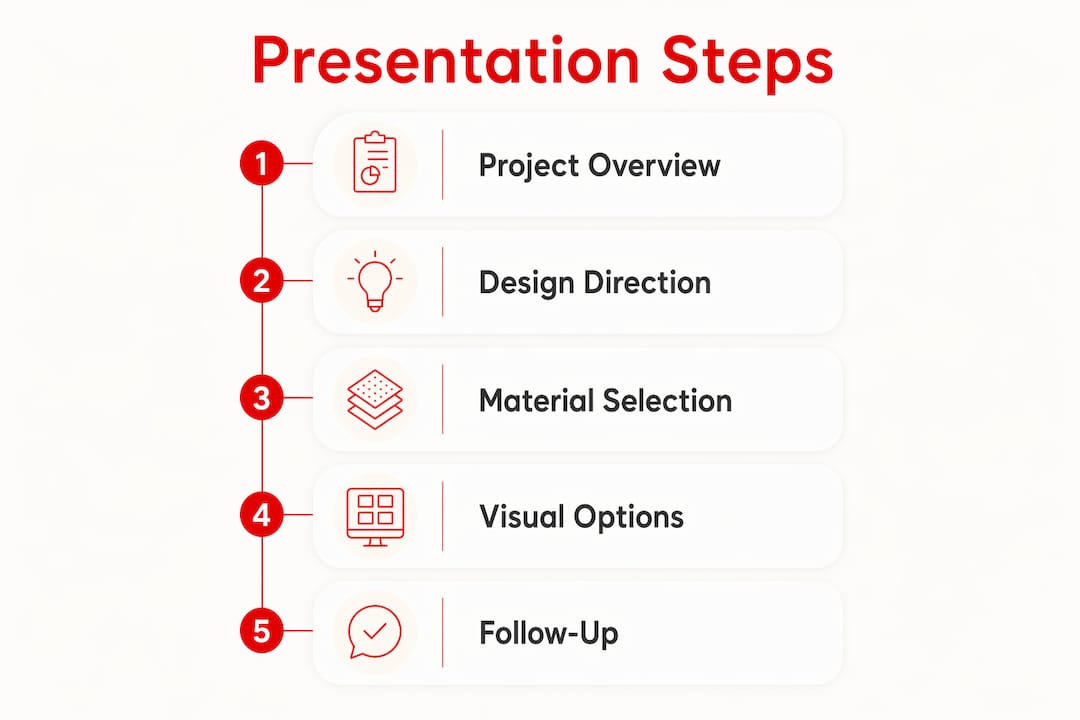
A structured presentation deck guides clients logically from vision to execution, covering project overview, design direction, palette, materials, floor plans, lighting, elevations, timeline, and budget. Each element serves a specific purpose. The project overview frames the context, reminding clients of the brief they shared and the goals the design is meant to achieve. The design direction section tells the story of the space, explaining why certain choices were made and how they connect to the client’s lifestyle.
Colour palettes and material selections are where many clients form their first emotional response. Showing actual material samples alongside digital swatches, rather than relying on screen colours alone, gives a far more accurate impression of how a space will feel. Floor plans and furniture layouts answer the practical question of whether everything fits and flows. Lighting plans and elevations answer the atmospheric question of how the space will look and feel at different times of day.

The final section of any strong presentation links concept to cost. A timeline and budget breakdown transforms an inspiring set of visuals into a credible plan. Clients in Singapore are particularly attentive to this stage because payment milestones are tied directly to project progress, making scope clarity a financial matter, not just an aesthetic one.
Here is a quick reference for the core components every presentation should include:
- Project overview: Restate the client brief and key goals to anchor the presentation
- Design direction: Narrative explanation of the concept, mood, and spatial logic
- Colour palette and materials: Physical or digital swatches with finish descriptions
- Floor plan and furniture layout: Scaled drawings showing spatial flow and proportions
- Lighting plan and elevations: Wall-by-wall views and lighting zones to communicate atmosphere
- Timeline and budget: Phased schedule with cost estimates linked to each stage
| Presentation element | Purpose |
|---|---|
| Project overview | Aligns client expectations with design intent |
| Colour and material board | Communicates tactile and visual quality |
| Floor plan and elevations | Confirms spatial logic and scale |
| Timeline and budget | Links concept to practical execution |
How do visuals and multiple design directions build client confidence?
Client hesitation most often arises when presentation visuals fail to communicate atmosphere, scale, or material quality. This means a beautiful floor plan alone is rarely enough. Clients need to feel what it would be like to stand in the finished room, and that requires a different level of visual investment.
3D visualisation is the most direct solution. Early use of 3D renderings in client consultations significantly improves spatial and material understanding, which speeds up approvals. A well-rendered living room showing afternoon light falling across a timber feature wall communicates more in ten seconds than ten minutes of verbal explanation. For Singapore homeowners dealing with compact HDB or condominium layouts, seeing furniture at true scale within the actual floor plan removes the single biggest source of doubt.
One of the most effective but underused strategies is presenting two or three design options rather than a single concept. Multiple clearly differentiated options increase client participation and decision confidence. When a client can compare a warm Japandi scheme against a cooler Scandinavian palette, they are no longer being asked to approve or reject one idea. They are being invited to choose, which feels very different. This also gives the designer valuable feedback about which direction genuinely resonates.
The quality of the rendering itself matters as much as the content. Flat or artificial renderings reduce client confidence because they make spaces feel sterile and unconvincing. Lighting and material reflections must be tuned carefully to create realism and atmosphere. Using multiple lighting presets, such as morning daylight versus evening ambient, shows how the same space transforms across a day and builds a richer sense of what the client is buying into.
Clients tend to evaluate the overall project quality through key spaces. Kitchens and bathrooms drive overall project confidence more than any other room. Prioritising photorealistic renders of these spaces, complete with accurate joinery profiles and surface finishes, anchors the client’s trust in the entire scheme. An AI-powered visualisation guide can also help homeowners understand how modern rendering tools work before they meet with a designer.
Pro Tip: When presenting 3D renders, always include one view that shows natural daylight and one that shows evening lighting. This single addition communicates spatial mood far more convincingly than any written description.
What communication strategies help designers convey concepts clearly?
Design presentations fail when designers show what they made rather than what clients need. Re-centring every presentation on the client’s own goals is the single most important communication discipline a designer can practise.
The most reliable way to do this is to open the presentation by restating the client brief in the client’s own words. This signals that the design is a direct response to their priorities, not a portfolio exercise. From that point, every design choice should be explained with a reference back to something the client said or requested. “You mentioned wanting the living area to feel open and connected to the dining space, so we removed the partition wall and used a continuous flooring material to draw the eye through” is far more persuasive than “we chose an open-plan layout.”
Here is a practical communication framework for presenting concepts effectively:
- Restate the brief: Open by summarising the client’s goals and lifestyle priorities in their own language
- Explain each choice: Link every design decision to a specific client need or preference
- Name and rank your options: Label each design direction clearly and offer a reasoned recommendation
- Invite structured feedback: Ask clients to distinguish between personal preference and strategic concern
- Send a follow-up summary: Deliver a written summary of decisions and next steps within 24 hours
Timely follow-up documentation after presentations sustains momentum and client trust. Sending a meeting summary within 24 hours demonstrates professionalism and prevents project stalls caused by fading memory or miscommunication. For Singapore projects where revision rounds can delay HDB renovation permit submissions, this discipline has real financial consequences.
Some Singapore clients, particularly those who have not renovated before, respond better to emotional language than technical specifications. Clients who express feelings like “warmth” or “a home that feels lived-in” rather than specifying finishes are signalling that they want the design to evolve through discovery. Recognising this and adjusting your language accordingly, using phrases like “this material will give the room a grounded, earthy quality” rather than “this is a 600×600 matte porcelain tile,” builds far stronger rapport. Understanding what a client brief involves before the first meeting makes this kind of adaptive communication much easier.
Pro Tip: After presenting options, ask: “Which of these feels closest to what you had in mind, and what would you change?” This separates emotional preference from practical concern and gives you cleaner feedback to work with.
How do Singapore payment milestones affect the presentation process?
Staged payments tied to verifiable milestones protect clients and directly influence how much clarity a concept presentation needs to contain. In Singapore, typical interior design payment structures follow a percentage-based schedule linked to completed work stages, with initial deposits around 10 to 15 per cent at contract signing and a final retention of 5 to 10 per cent held until defect clearance.
This structure means that what a designer presents at the concept stage defines the scope of work that the entire payment schedule is built upon. Vague or incomplete presentations create scope gaps that surface later as variation orders, which are additional charges for work not originally specified. Clear presentations that include an itemised bill of quantities, or at minimum a detailed scope description, protect both parties.
| Payment stage | Typical percentage | What it should be tied to |
|---|---|---|
| Signing deposit | 10–15% | Signed contract and approved concept |
| Hacking and masonry | 20–25% | Verified completion of structural works |
| Carpentry and joinery | 30–35% | Confirmed installation of built-in items |
| Final handover | 5–10% | Defect clearance and client sign-off |
Payments not tied to verifiable milestones cause client distrust, and clear presentations that define scope reduce this risk significantly. Homeowners should treat any request for an unusually large upfront deposit, above 20 per cent, or payment to a personal rather than company account as a warning sign. A well-presented concept that maps directly to a transparent payment schedule is one of the clearest signals that a designer operates professionally.
Key takeaways
A successful interior design concept presentation combines realistic visuals, structured narrative, and transparent cost planning to move clients from uncertainty to confident approval.
| Point | Details |
|---|---|
| Structure drives clarity | Every presentation needs a project overview, materials, floor plans, and a budget breakdown. |
| Visuals must communicate atmosphere | 3D renderings with tuned lighting outperform flat plans for client understanding and approval speed. |
| Multiple options increase confidence | Presenting two or three named design directions invites client choice rather than a simple yes or no. |
| Communication centres on the client | Linking every design decision back to the client brief reduces revision cycles and builds trust. |
| Payment clarity protects both parties | Staged payments tied to verified milestones depend on a clearly scoped concept presentation from the start. |
Why the emotional layer matters more than the checklist
I have reviewed enough interior design presentations to know that the ones clients remember, and approve fastest, are rarely the most technically complete. They are the ones that made the client feel something. A mood board that captures the exact quality of morning light a client described wanting in their bedroom will do more work than a perfectly formatted bill of quantities.
What I find consistently underestimated is the power of restraint in a presentation. Designers who show everything they know tend to overwhelm clients. The ones who show only what is relevant to that specific client’s brief, and explain it in plain language, earn trust far more quickly. I have seen Singapore homeowners stall for weeks on a technically excellent presentation because it felt like it was designed for someone else.
The other thing worth saying plainly is that concept board clarity prevents the kind of costly misalignment that shows up at the joinery stage, when it is too late to change direction without paying for it. Designers who invest in a thorough, emotionally resonant presentation at the start spend far less time managing unhappy clients later. That is not just good practice. It is good business.
— Jonathan
Find trusted interior design professionals at Tspacemall
Tspacemall is a one-stop renovation and home living mall in the East of Singapore, connecting homeowners with vetted interior design firms, renovation contractors, and home décor specialists all in one place. Whether you are collecting keys to a new BTO flat or planning a condominium refresh, the experts at Tspacemall can help you move from concept to completion with confidence.
Browse the Absolook Interior Design directory on Tspacemall to explore professional design services tailored to Singapore homeowners. You can also discover Woodcraft Interior Design and other trusted firms ready to bring your vision to life. Visit Tspacemall today to start your home transformation.
FAQ
What should an interior design concept presentation include?
A complete presentation covers the project overview, design direction, colour palette, material selections, floor plans, lighting plans, elevations, timeline, and budget breakdown. This structure guides clients logically from concept to execution and supports faster approvals.
How many design options should a designer present to a client?
Presenting two or three clearly differentiated options is more effective than a single concept. Multiple options increase client participation and reduce the pressure of approving or rejecting one idea outright.
Why do clients hesitate to approve interior design concepts?
Client hesitation most often stems from presentation visuals that fail to communicate atmosphere, scale, or material quality. Realistic 3D renderings with accurate lighting significantly reduce this uncertainty.
How do Singapore payment milestones relate to concept presentations?
Staged payment schedules in Singapore are built on the scope defined at the concept stage. A clear, detailed presentation prevents variation orders and payment disputes later in the project.
How soon should a designer send follow-up documents after a presentation?
Meeting summaries should be sent within 24 hours of the presentation. Timely follow-up sustains project momentum and prevents decisions from stalling due to miscommunication.
Recommended


