
Discover the ultimate new homeowner furniture buying checklist for Singapore. Furnish your space efficiently and stylishly without overspending!


A new homeowner furniture buying checklist is a structured room-by-room guide that helps you furnish your Singapore BTO or condo flat efficiently, without wasting money on pieces that do not fit your space or lifestyle. Getting this right from the start matters more than most first-time buyers expect. The difference between a comfortable home and a cluttered one often comes down to decisions made before a single item is purchased. This guide covers what to buy first, how to measure correctly, which space-saving furniture types work best in compact Singapore homes, and how to manage delivery without costly surprises.
1. What every new Singapore homeowner should buy first
The BTO furniture checklist from Nova Furnishing defines the non-negotiables clearly: bed and mattress, sofa, dining set, key appliances, lighting, and curtains. These are the pieces that make a home livable from day one. Everything else, including decorative shelving, accent chairs, and artwork, can wait until you have lived in the space and understand how you actually use it.
Start with these foundational categories:
- Bedroom: Bed frame and mattress (prioritise comfort and storage options), bedside tables, wardrobe
- Living room: Sofa or sofa bed, coffee table, TV console
- Dining area: Dining table and chairs suited to your household size
- Kitchen: Refrigerator, washing machine, cooker hood, and hob
- Lighting: Ceiling lights for every room, plus bedside or task lamps
- Window treatments: Curtains or blinds to manage Singapore’s intense afternoon sun
The logic behind this order is simple. Foundational everyday-use pieces make your home livable quickly, and style choices can be layered in later once you know what the space needs. Buying a statement armchair before you have a sofa is a common and expensive mistake.
Pro Tip: Pack a first-night essentials box with bedding, toiletries, phone chargers, and basic kitchen items before your furniture arrives. This move-in essentials box prevents the stress of rummaging through packed bags on your first night.
2. How to measure your space before buying anything
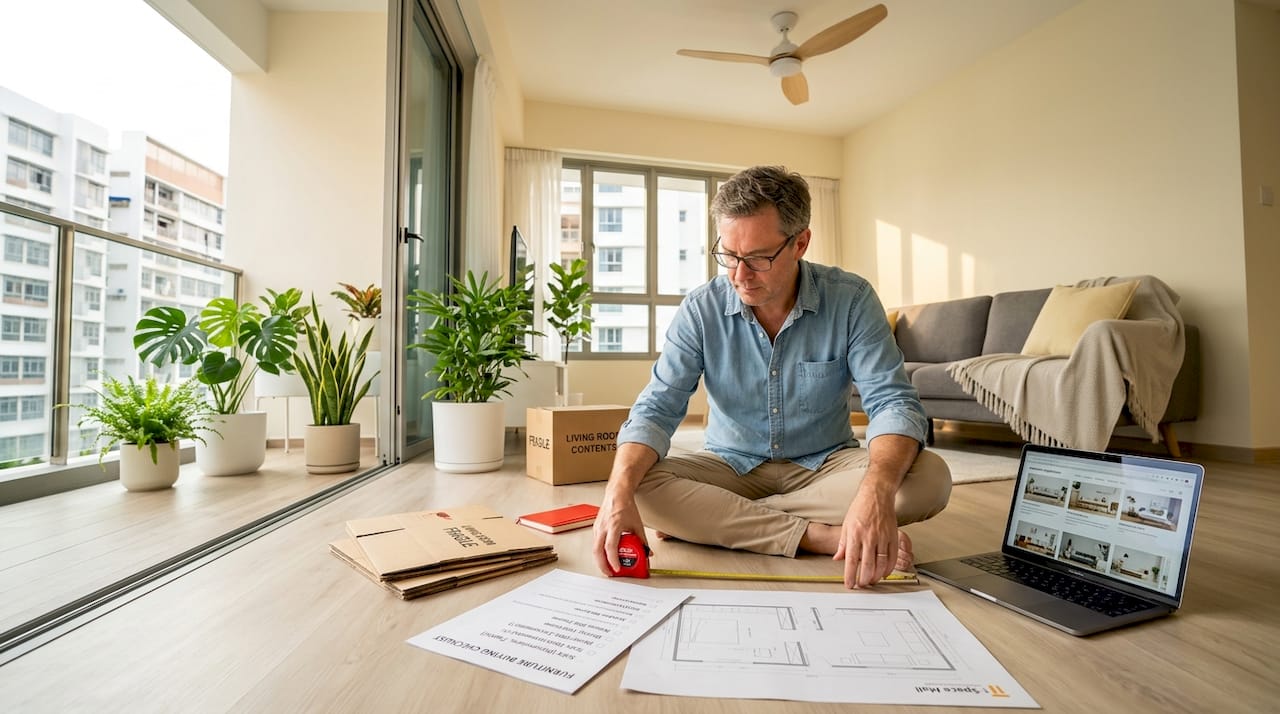
Measurement is the single step most new homeowners skip, and it causes more failed deliveries and awkward furniture arrangements than any other mistake. Before visiting any showroom or browsing any catalogue, you need four numbers for every room: length, width, ceiling height, and the width of every doorway and corridor on the delivery path.
Tools and technique
Use a steel measuring tape rather than a fabric one, as fabric tapes stretch and give inaccurate readings over longer distances. A laser distance measurer, such as the Bosch GLM 50 C, speeds up the process significantly in larger rooms. Record every measurement in a notebook or a planning app like Planner 5D, and photograph each wall with a tape measure visible for reference when you are in a showroom.
Clearance standards to follow
The 36-inch walkway rule from VBU Furniture is the standard for comfortable movement through a living room. In tighter spaces, 30 inches is the minimum. Dining chairs require approximately 24 inches of clearance behind them so people can pull out and sit without hitting a wall.
| Area | Recommended clearance | Minimum clearance |
|---|---|---|
| Main walkways | 36 inches (91 cm) | 30 inches (76 cm) |
| Behind dining chairs | 24 inches (61 cm) | 18 inches (46 cm) |
| Beside the bed | 24 inches (61 cm) | 18 inches (46 cm) |
| In front of wardrobe | 36 inches (91 cm) | 30 inches (76 cm) |
One often-overlooked measurement
In BTO flats, record power point locations early in your planning process. Placing a sofa or bed over a power point forces you to rely on extension cords, which creates both a safety hazard and a visual mess. Mark socket positions on your floor plan before you finalise any furniture layout.
Pro Tip: Use painter’s tape on the floor to outline the footprint of each furniture piece before you buy. This costs nothing and immediately shows whether a sofa or dining table will dominate the room or leave comfortable space around it.
3. Space-saving furniture types that work best in compact homes
Furniture buying in Singapore BTOs must be driven by space efficiency and multi-functionality because the average three-room BTO flat offers roughly 65 square metres of floor area. That constraint changes how you should evaluate every piece. A beautiful solid-wood dining table that seats eight is not a good purchase for a flat that comfortably fits four.
These are the furniture types that consistently deliver the best return on floor space:
- Storage beds with hydraulic lifts: The space beneath a bed is the largest unused volume in most Singapore bedrooms. A hydraulic storage bed turns that space into a clean, accessible storage zone for luggage, seasonal items, and bedding.
- Sofa beds: A sofa bed with built-in storage works as a guest bed, a living room seat, and a storage unit simultaneously. For compact flats, this replaces the need for a separate guest room.
- Extendable dining tables: A two-seater table that extends to seat six handles both daily meals and occasional gatherings without permanently occupying the extra floor space.
- Sliding wardrobes: Unlike hinged-door wardrobes, sliding wardrobes require zero clearance in front of them for door swing. In a bedroom where every centimetre counts, this difference is significant.
- Vertical storage: Tall bookshelves, wall-mounted cabinets, and pegboards draw the eye upward and use wall height rather than floor area.
For a deeper look at compact bedroom storage, the principle is consistent: go vertical before going wide, and choose pieces that serve two functions before buying anything that serves only one.
| Furniture type | Primary function | Secondary function | Floor space saved |
|---|---|---|---|
| Storage bed | Sleeping | Storing luggage and linens | Replaces separate storage unit |
| Sofa bed | Seating | Guest sleeping | Replaces guest bed |
| Extendable dining table | Daily dining | Entertaining guests | Replaces larger fixed table |
| Sliding wardrobe | Clothing storage | No door swing clearance needed | Saves 60 to 90 cm depth |
4. How to coordinate furniture delivery in Singapore homes
Delivery constraints vary significantly by housing type in Singapore. HDB flats impose the tightest limits because corridor widths and lift dimensions are standardised and relatively narrow. Condo developments vary more widely, and landed homes generally present the fewest constraints. Understanding your specific building before ordering is not optional.
Here is a practical delivery coordination process:
- Measure the full delivery path. Measure doorways, hallways, and corridor turns including any moulding or fixtures that reduce the usable width. A sofa that fits through the lift may still fail at a corridor turn.
- Check corridor turning radii. In HDB flats, corridor turning radii break sofa delivery feasibility more often than lift size does. A straight three-seater sofa that fits the lift may be impossible to turn into the flat entrance.
- Consider modular furniture. Modular sofas and sectional wardrobes are delivered in sections and assembled inside the flat, bypassing corridor constraints entirely.
- Align your order timing with your renovation schedule. Custom furniture requires four to eight weeks lead time, so orders placed at key collection will not arrive until well after renovation is complete. Place orders early.
- Ventilate before moving furniture in. Ventilate your newly renovated home for at least 7 to 14 days before bringing in furniture. Post-renovation VOC emissions from paint and carpentry are highest in the first eight weeks, and furniture traps those compounds rather than allowing them to dissipate. Timing matters more than any air purifier here.
For a broader view of how renovation timing connects to furniture buying, the first home renovation checklist at Tspacemall maps out the full sequence from HFE letter to move-in day.
Key takeaways
A well-executed new homeowner furniture buying checklist prioritises livability first, space efficiency second, and aesthetics third, with delivery logistics planned before a single order is placed.
| Point | Details |
|---|---|
| Buy essentials first | Bed, sofa, dining set, and appliances make the home livable before style pieces are added. |
| Measure before you shop | Record room dimensions, power point locations, and the full delivery path before visiting any showroom. |
| Choose multi-functional pieces | Storage beds, sofa beds, and extendable tables maximise function in compact BTO and condo flats. |
| Plan delivery logistics early | Check corridor turning radii and lift dimensions, and consider modular furniture for tight HDB corridors. |
| Ventilate before move-in | Allow 7 to 14 days of ventilation after renovation before bringing furniture into the home. |
What I have learnt from watching homeowners furnish their first Singapore flat
The most consistent mistake I see is buying furniture in the wrong order. Homeowners fall in love with a statement piece, a dramatic sectional sofa or an oversized dining table, and build the rest of the room around it. That approach works in large homes. In a three-room BTO flat, it produces a room that looks good in photographs and feels cramped to live in.
The second mistake is treating furniture shopping as a single event rather than a process. Your taste will shift after you have lived in the space for three months. The curtain colour that seemed perfect in the showroom may clash with the flooring once the afternoon light hits it. Buy the essentials on day one, live in the space, and make considered choices about the rest.
What I find genuinely underrated is the interior design software tools available to Singapore homeowners today. Spending two hours with a free planning tool before stepping into a showroom saves far more time and money than any discount or sale. You walk in knowing exactly what dimensions you need, and you leave with the right piece rather than a hopeful guess.
The process does not need to feel overwhelming. Treat it as a series of small, well-informed decisions rather than one enormous project, and the home comes together more naturally than you expect.
— Jonathan
Furnish your new home with confidence at Tspacemall

Tspacemall brings together Singapore’s most trusted interior design firms and furniture specialists under one roof in the East of Singapore, making it the natural starting point for new homeowners who want expert guidance without the legwork. Whether you need a full furnishing package or advice on a single room, Absolook Interior Design offers tailored solutions for new BTO and condo owners, while Woodcraft Interior Design specialises in custom storage and space-saving furniture built for compact Singapore homes. Visit Tspacemall to explore the full directory of home and living specialists ready to help you move in with confidence.
FAQ
What furniture should I buy first for a new BTO flat?
Buy your bed and mattress, sofa, dining set, and major appliances first. These are the pieces that make the home functional from day one, and everything else can be added once you have lived in the space.
How much clearance should I leave around furniture?
Maintain at least 36 inches (91 cm) for main walkways and 24 inches (61 cm) behind dining chairs and beside the bed. In very tight spaces, 30 inches is the workable minimum for walkways.
Why does my sofa need to fit the corridor, not just the lift?
In HDB flats, corridor turning radii are often the binding constraint on sofa delivery, not the lift dimensions. A straight three-seater may fit the lift but be impossible to turn into the flat entrance, making modular sofas a safer choice.
How long should I wait after renovation before moving furniture in?
Ventilate your home for at least 7 to 14 days after renovation before bringing in furniture. VOC emissions from paint and carpentry are highest in the first eight weeks, and early ventilation significantly reduces your exposure.
How far in advance should I order custom furniture?
Custom furniture in Singapore typically requires four to eight weeks lead time. Place your orders at or shortly after key collection to avoid delays, and align delivery timing with the end of your renovation works.
Recommended


