
Discover the role of mirror interior design in your home. Learn how mirrors enhance space, light, and style in our 2026 guide!


Mirrors are one of the most underestimated tools in any homeowner’s decorating kit. Most people hang one above the bathroom vanity, perhaps another in the hallway, and consider the job done. But the role of mirror interior design goes far deeper than simple reflection. Mirrors transform how a space feels by interacting with light, movement, and perspective in ways that no paint colour or furniture arrangement can fully replicate. Whether you are settling into your first home or giving a familiar room a fresh perspective, understanding how mirrors truly work will change the way you see every wall in your home.
Table of Contents
- Key takeaways
- How mirrors reshape space and perception
- Optimising light with mirrors
- Choosing the right mirror size and style
- Creative and decorative mirror ideas
- Common mistakes and expert placement tips
- My honest take on mirrors in the home
- Transform your home with expert mirror guidance
- FAQ
Key takeaways
| Point | Details |
|---|---|
| Mirrors reshape perception | Strategic placement extends sightlines and makes rooms feel more open without structural changes. |
| Light amplification matters | Mirrors placed near windows or lamps distribute both natural and artificial light more evenly. |
| Sizing follows proportion rules | A bathroom mirror should be 70–75% of the vanity width to balance function and visual harmony. |
| Reflections require curation | Aim mirrors at artwork, greenery, or architectural features rather than clutter or blank walls. |
| Glare is a real risk | Avoid placing mirrors directly opposite windows to prevent harsh glare and unwanted heat gain. |
How mirrors reshape space and perception
The importance of mirrors in design begins with a simple truth. A mirror does not add space to a room; it borrows it. By reflecting what lies across the room, a well-placed mirror extends the viewer’s sightline beyond the physical wall boundary, which the brain interprets as depth. The result is a room that feels wider, taller, or more open than it actually is.
Small rooms benefit enormously from this principle. Placing a large mirror on a narrow wall, for instance along a corridor or the shorter end of a rectangular living room, effectively doubles the perceived length of that space. A floor-length mirror leaning against a wall in a compact bedroom creates a vertical sweep that draws the eye upward, making ceilings feel higher. Horizontal mirrors, by contrast, widen rooms that feel pinched.
Using mirrors for space enhancement works best when you are deliberate about what the mirror reflects. The goal is to extend a pleasant vista, not simply add more glass to the room. Here are the most effective placement strategies:
- Opposite an interesting view. Position mirrors to reflect a window, an artwork, or a well-styled shelf. This layers visual interest rather than just doubling empty space.
- Along a narrow wall. A full-width or oversized mirror on the shortest wall of a room makes it read as far less confined.
- At the end of a hallway. This classic trick makes corridors feel like they continue rather than dead-end.
- Behind a console or sideboard. A mirror here creates the impression of a deeper room behind the furniture and is particularly effective in entrance halls.
Pro Tip: Before drilling any holes, hold the mirror in place and check the reflection from every position you typically occupy in the room, including seated. What the mirror shows from your sofa is just as important as what it shows from the doorway.
The most common mistake is reflecting clutter. A mirror opposite a messy kitchen counter or a wall of tangled cables simply doubles the problem. The mirror’s effect depends entirely on what it reflects, not just its surface area.
Optimising light with mirrors
Mirrors act like a second source of light in a room. They do not generate light, but they can redistribute it so effectively that the room feels as though another window has appeared. This is one of the most practical benefits of mirrors in interiors, especially in Singapore’s HDB flats or BTOs where natural light is often limited to one or two sides of the apartment.
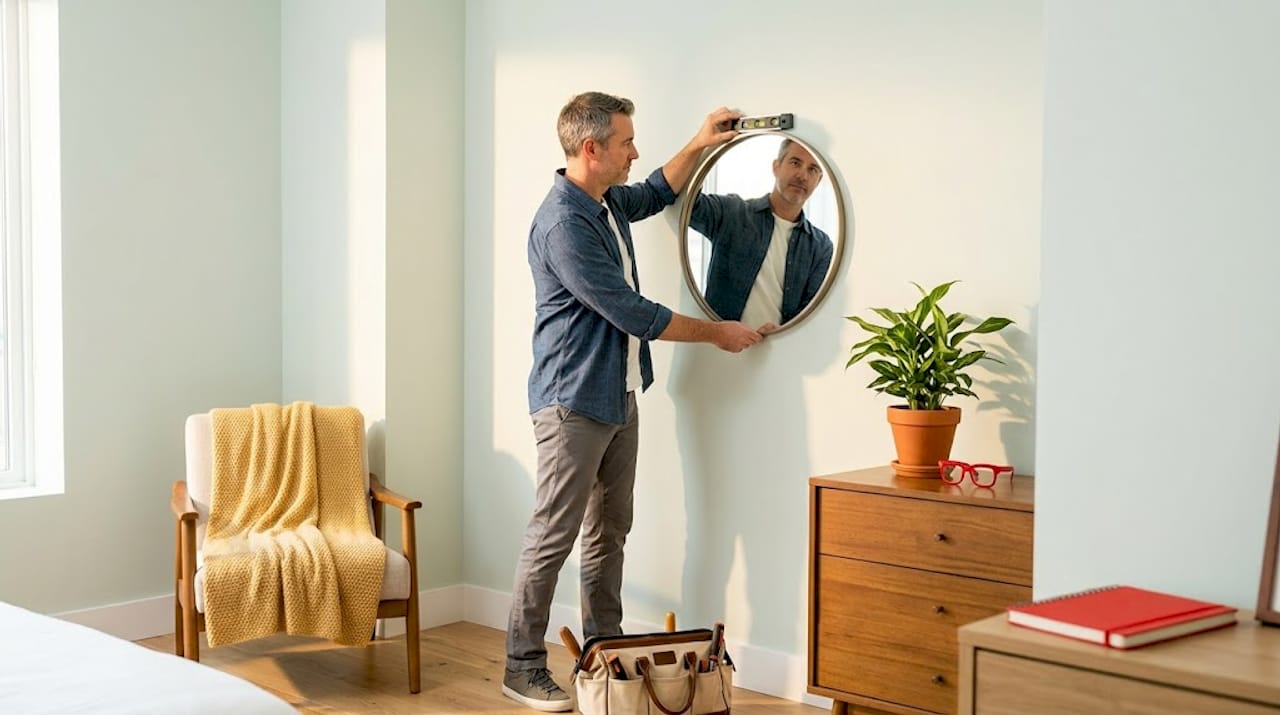
The most powerful use is placing a mirror perpendicular to a window rather than directly opposite it. This placement catches daylight as it enters and bounces it sideways into darker corners without creating glare. Mirrors placed straight across from windows cause specular reflection, which means the beam of light is thrown back intensely rather than diffused softly. In tropical climates, this also increases heat gain, making the room feel warmer and less comfortable.
Artificial lighting benefits from mirrors just as much as natural light. Mirrors amplify lamps and wall sconces, creating layered lighting effects that reduce dependence on harsh overhead fixtures. A well-placed mirror beside a floor lamp, for example, can make a dim corner feel as bright as the centre of the room. If you are exploring bedroom lighting ideas for an awkward space, a strategically angled mirror is often the simplest solution.
When selecting glass for maximum light effect, consider these options:
- Clear float glass reflects the sharpest, brightest image and is best for light distribution.
- Antiqued or smoked glass diffuses light gently, adding warmth rather than brightness.
- Bronze-tinted mirrors suit warmer colour palettes and create a golden ambient glow.
- Bevelled edge mirrors refract light at the edges, casting small prisms of light that add texture to a room.
Pro Tip: For north-facing rooms that receive no direct sunlight, place a large clear mirror on the wall adjacent to the main window. This single change can visibly brighten the entire room throughout the day without touching the electrical fittings.
Choosing the right mirror size and style
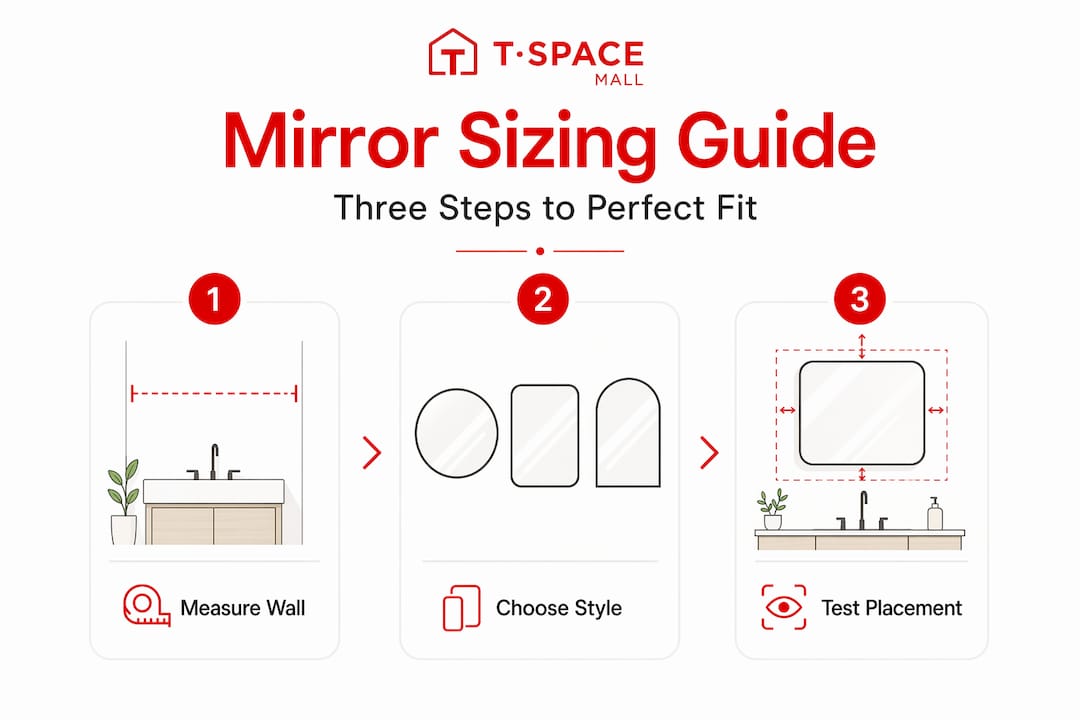
Getting the size right is where many homeowners go wrong. A mirror that is too small for its wall looks apologetic. One that is too large overwhelms the furniture beneath it. The importance of mirrors in design lies partly in their proportions, and those proportions are governed by the furniture and architecture around them.
Here is a practical sizing approach for the most common rooms:
- Bathroom. A bathroom mirror should be 70–75% of the vanity width and centred at 60–65 inches from the floor for comfortable eye-level viewing. For a 48-inch vanity, that means a mirror roughly 34–36 inches wide.
- Living room. Position a mirror so its centre sits at approximately 57–60 inches from the floor, which aligns with average eye level when standing. This keeps it from feeling like it is floating near the ceiling.
- Hallway. A full-length or near-floor-to-ceiling mirror works well here because hallways are transitional spaces where checking your appearance is genuinely useful.
- Small kitchen. A mirrored splashback or a single well-placed panel can visually expand a compact kitchen without a renovation.
| Room | Recommended size | Best placement |
|---|---|---|
| Bathroom | 70–75% of vanity width | Centred above vanity |
| Living room | 60–80cm wide minimum | Above fireplace or console |
| Hallway | Full length if possible | End wall or beside door |
| Bedroom | At least half door height | Behind door or on wardrobe wall |
Frame style matters too. A slim, brushed-brass frame reads as contemporary without being cold. Heavy ornate frames suit traditional or maximalist interiors. Frameless mirrors work in minimalist spaces but can feel stark in warmer, cosier rooms. LED-integrated mirrors, now widely available, combine task lighting with reflection in bathrooms and dressing areas, reducing the need for separate vanity lighting.
Pro Tip: When in doubt about size, cut a paper template to the mirror’s dimensions and tape it to the wall for a day before committing. Living with the proportions for 24 hours tells you far more than any measuring tape will.
Creative and decorative mirror ideas
Beyond the practical, mirrors and interior aesthetics come together most powerfully when mirrors are treated as art objects or architectural features in their own right. This is where mirrors as focal points in rooms become genuinely exciting for design enthusiasts.
Mirrors can create optical illusions in windowless or low-light areas through creative placement. Mirrored panels running floor to ceiling on one wall of a dining room, for instance, visually double the room and create a sense of occasion without requiring structural changes. Fanlights with mirror inserts above internal doors bounce light from one room into another, solving common dark-corridor problems elegantly.
Statement mirrors deserve particular attention as a design choice. A single, large, architecturally distinctive mirror above a fireplace or console table functions exactly like a piece of artwork. It anchors the wall, provides a focal point, and gives the eye somewhere to rest. Antique and distressed mirrors add character that new glass cannot replicate. The slight cloudiness and tonal variation in aged glass creates warmth, and the imperfect reflections are less confrontational than the sharp clarity of modern mirrors.
Here are some creative mirror design ideas worth exploring:
- Gallery wall of mirrors. Mixing frames in complementary finishes creates a curated look that is both decorative and spatially expansive.
- Mirrored furniture. A mirrored side table or cabinet front catches light at floor level, brightening lower parts of the room that ceiling lights rarely reach.
- Geometric mirror clusters. Hexagonal or asymmetric shapes grouped together act as sculptural wall art while still reflecting light.
- Mirrored wardrobe doors. These are a practical double win in bedrooms: they replace the need for a separate full-length mirror while making the room feel substantially larger.
When thinking about what reflections to aim for, the principle remains the same as in the basics. [Mirrors work best reflecting attractive elements](https://www.coohom.com/article/how-interior-designers-use-mirrors-to-make-small-rooms look-bigger) such as artwork, greenery, or architectural details. A mirror angled to reflect a well-styled bookshelf creates a layered, interesting view. One that reflects a television or a wall socket does not.
Common mistakes and expert placement tips
Even homeowners who understand the theory of mirrors make placement errors that undermine the effect. Mirror placement in home decor is as much about avoiding mistakes as it is about getting things right.
The most persistent error is placing a mirror directly opposite a window. The logic seems sound: the mirror will reflect the light and brighten the room. In practice, perpendicular or angled placement does this far more effectively. Direct opposite placement creates a blinding glare patch on sunny days and, in Singapore’s heat, actively warms the room by reflecting solar radiation back into the space.
Other common mistakes include:
- Two mirrors facing each other. This creates an infinite reflection tunnel that is visually distracting and can feel unsettling in a living space. Separate mirrors by at least two wall lengths.
- Mirror positioned too high. A mirror hung so its centre is above 60 inches from the floor feels disconnected from the room and only reflects the ceiling.
- Ignoring the reflection test. Always sit in the seats you use most in a room and check what the mirror reflects from that position. What is reflected at seated eye level is what you will see for most of your time in that room.
- Choosing a mirror before the furniture. Mirrors should respond to the room’s existing composition. Buying a mirror first and then arranging furniture around it rarely produces a balanced result.
Pro Tip: If you are working with a very small room, one large mirror outperforms several small ones every time. Multiple small mirrors create a fragmented visual effect that reads as busy rather than spacious.
Cleaning and maintenance are also worth planning for before installation. A large mirror on a feature wall needs to be reachable without a ladder for regular cleaning. Mirrors in kitchens attract grease and steam; sealed frames and anti-fog coatings make maintenance far more manageable in those environments.
My honest take on mirrors in the home
I’ve worked with enough homeowners to know that mirrors are the single most underused tool in a decorator’s kit. People spend thousands on paint, furniture, and lighting, then hang a small mirror beside the front door as an afterthought.
What I’ve found is that the real power of a mirror lies in its relationship with light. When I see a room that feels dark and closed despite good furniture and fresh paint, my first instinct is always to look at how light moves through the space and where a mirror could redirect it. That single change, no structural work required, transforms the atmosphere more than almost anything else.
The mistake I see most often from new homeowners is choosing mirrors purely for appearance. A beautiful antique frame in the wrong position, reflecting nothing but a blank wall, is a wasted opportunity. Before you buy, stand in the room and ask: what do I want this mirror to show me? That question alone puts you ahead of most people.
I also believe the emotional effect of mirrors is underestimated. A home that feels bright, open, and balanced has a genuine impact on mood. I’ve seen compact apartments become places people genuinely love to be in, simply because light was handled thoughtfully. Mirrors, when placed with intention, are one of the most affordable ways to get there. If you are new to this, consider reading about visual space expansion techniques before making your first major mirror purchase.
— Jonathan
Transform your home with expert mirror guidance
Knowing the principles is one thing. Applying them in your specific home, with its particular proportions, light conditions, and style, is where professional guidance pays off enormously. The team at Tspacemall connects Singapore homeowners with experienced interior designers who understand exactly how to use mirrors to reshape a space, not just decorate it.

Whether you are working with a compact BTO flat or a larger resale property, the interior designers at Absolook have the experience to recommend the right mirror sizes, positions, and styles for each room in your home. For broader renovation and styling support, the Home & Living renovation directory at Tspacemall gives you access to a curated range of professionals who specialise in customised room styling, including mirror integration that genuinely works. You can also browse budget-friendly styling advice if you are working with tighter constraints.
FAQ
How does mirror placement affect room size?
Mirrors extend the viewer’s sightline beyond the physical wall, making rooms feel larger without any structural changes. Placing a large mirror on a narrow wall or at the end of a hallway is especially effective.
Where should I avoid hanging a mirror?
Avoid placing mirrors directly opposite windows, as this creates glare and, in warm climates, increases heat gain in the room. A perpendicular or angled placement distributes light far more comfortably.
What size mirror works best above a bathroom vanity?
A bathroom mirror should be approximately 70–75% of the vanity’s width, centred at 60–65 inches from the floor. For a standard 48-inch vanity, this means a mirror around 34–36 inches wide.
Can mirrors be used as focal points instead of artwork?
Yes. A large, architecturally distinctive mirror above a fireplace or console table anchors a wall and provides a clear focal point in the same way a painting would, while also contributing light and spatial depth.
How do mirrors improve lighting in dark rooms?
Mirrors amplify both natural and artificial light, bouncing it into darker corners and creating a layered effect that reduces reliance on overhead fixtures. Placing a large clear mirror adjacent to the main window is one of the most effective ways to brighten a north-facing room.
Recommended


